
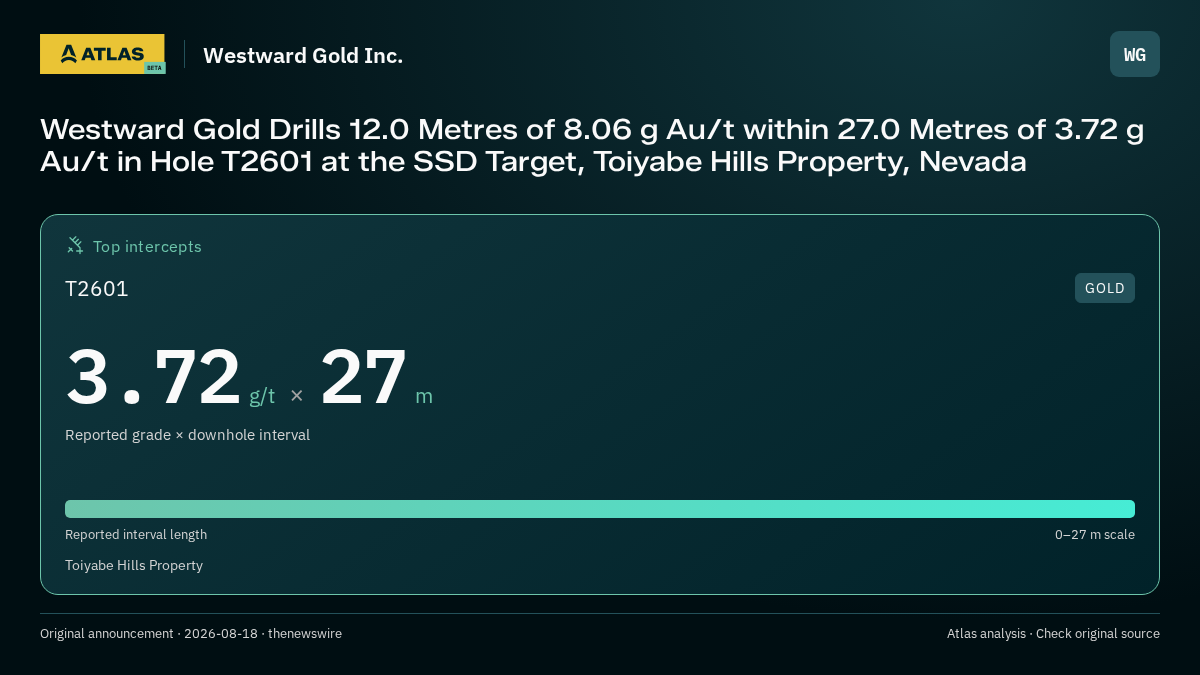
Westward Gold Drills 12.0 Metres of 8.06 g Au/t within 27.0 Metres of 3.72 g Au/t in Hole T2601 at the SSD Target, Toiyabe Hills Property, Nevada
Original announcement by thenewswire on
- Company
- Westward Gold Inc.
- Ticker
- WG
- Exchange
- Unavailable
- Region
- Nevada
- Primary commodity
- Gold
- Secondary commodities
- None reported
- Document categories
- Drill results
- Extracted
- 2026-08-20 02:07:21 UTC
Analysis by Minestarters Atlas
Minestarters Atlas analysis
Summary
Westward Gold has reported high-grade gold drill results from hole T2601 at the SSD Target in Nevada, including 12.0 metres at 8.06 g/t Au within a 27.0 metre intercept of 3.72 g/t Au. The results confirm that high-angle structural controls identified in recent trenching persist at depth, supporting the company's geological model for Carlin-style mineralization.
Reasoning: The intercept of 12.0m at 8.06 g/t Au is a strong result for a Carlin-style gold system, confirming previous trenching vectors and providing significant thickness of mineralization.
Positive factors
- High-grade intercept (8.06 g/t Au) in a Carlin-style deposit
- Confirms structural controls observed in trenching
- Significant width (27m) of mineralization
Negative factors
- True width not explicitly stated (estimated at 50-70% of apparent width)
Facts used in scoring: 2
Classification and evidence
QA/QC Disclosedpositive
Release includes QA/QC disclosure — certified lab, QP sign-off, or stated methods (blanks, standards, duplicates).
Why it applies: The release details a best-practices QA/QC program including standards, blanks, and duplicates, with ALS as the laboratory.
Evidence · text
“The Company implemented a best-practices QA/QC program during the drilling of core hole T2601.”
Apparent Width Onlynegative
Interval given as downhole width with no true width or drill orientation — apparent width may overstate true thickness.
Why it applies: The company explicitly states that true thicknesses are currently unknown and estimated at 50-70% of reported thicknesses.
Evidence · text
“true thicknesses of mineralization are currently unknown and estimated at 50-70% of reported thicknesses”
Extracted facts
Stored fact records: 2. Some facts used in scoring do not have a stored record.
Drill Results (2)
T2601Toiyabe Hills Property · goldGrade: 8.06Grade Unit: g/tIntercept: 12 mView all detailsHide details
Identity
- Hole ID
- T2601
- Project
- Toiyabe Hills Property
- Commodity
- gold
- Region
- usa_nv
- Reported Region
- Nevada
- Ticker
- WG
Geometry
- Grade
- 8.06
- Grade Unit
- g/t
- Intercept
- 12 m
- Hole Depth
- 122.7 m
Classification
- Sample Type
- drill
- Group ID
- T2601:unknown-unknown
- Mining Method
- unknown
QA/QC
- Laboratory
- ALS
- QA/QC Disclosed
- Yes
- Lab Certified
- Yes
- QP Signed
- Yes
- QA/QC Methods
- standards, blanks, duplicates
Review
- Needs Review
- No
- Interp. Status
- scored
- Historical
- No
Dates
- Event date
- 2026-08-18T00:00:00.000Z
Reasoning: 8.06 g/t Au is an exceptional grade for this deposit type.
Positive factors
- High grade for Carlin-style gold
Evidence · text
“12.0 Metres of 8.06 g Au/t”
T2601Toiyabe Hills Property · goldGrade: 3.72Grade Unit: g/tIntercept: 27 mView all detailsHide details
Identity
- Hole ID
- T2601
- Project
- Toiyabe Hills Property
- Commodity
- gold
- Region
- usa_nv
- Reported Region
- Nevada
- Ticker
- WG
Geometry
- Grade
- 3.72
- Grade Unit
- g/t
- Intercept
- 27 m
- Hole Depth
- 122.7 m
Classification
- Sample Type
- drill
- Group ID
- T2601:unknown-unknown
- Mining Method
- unknown
QA/QC
- Laboratory
- ALS
- QA/QC Disclosed
- Yes
- Lab Certified
- Yes
- QP Signed
- Yes
- QA/QC Methods
- standards, blanks, duplicates
Review
- Needs Review
- No
- Interp. Status
- scored
- Historical
- No
Dates
- Event date
- 2026-08-18T00:00:00.000Z
Reasoning: A 27m intercept at 3.72 g/t Au provides substantial mineralized volume.
Positive factors
- Significant width of mineralization
Evidence · text
“27.0 Metres of 3.72 g Au/t”
How Atlas produces this analysis
Minestarters Atlas uses automated extraction to summarize mining announcements, identify reported measurements, and classify supporting evidence. Sentiment reflects the extracted narrative and classification rules; it is an interpretation, not a reported measurement. Evidence quotes and context are provided where available. Missing data, low-confidence results, and review flags indicate limitations. Check the original publisher announcement before relying on an interpretation.