
Total Metals Corrects Disclosure on Menary Gold Project Acquisition
Original announcement by tmx on
- Company
- Total Metals Corp.
- Ticker
- TT
- Exchange
- TSX
- Region
- Ontario
- Primary commodity
- Gold
- Secondary commodities
- None reported
- Document categories
- Agreement transaction, Drill results
- Extracted
- 2026-08-21 00:49:28 UTC
Analysis by Minestarters Atlas
Minestarters Atlas analysis
Summary
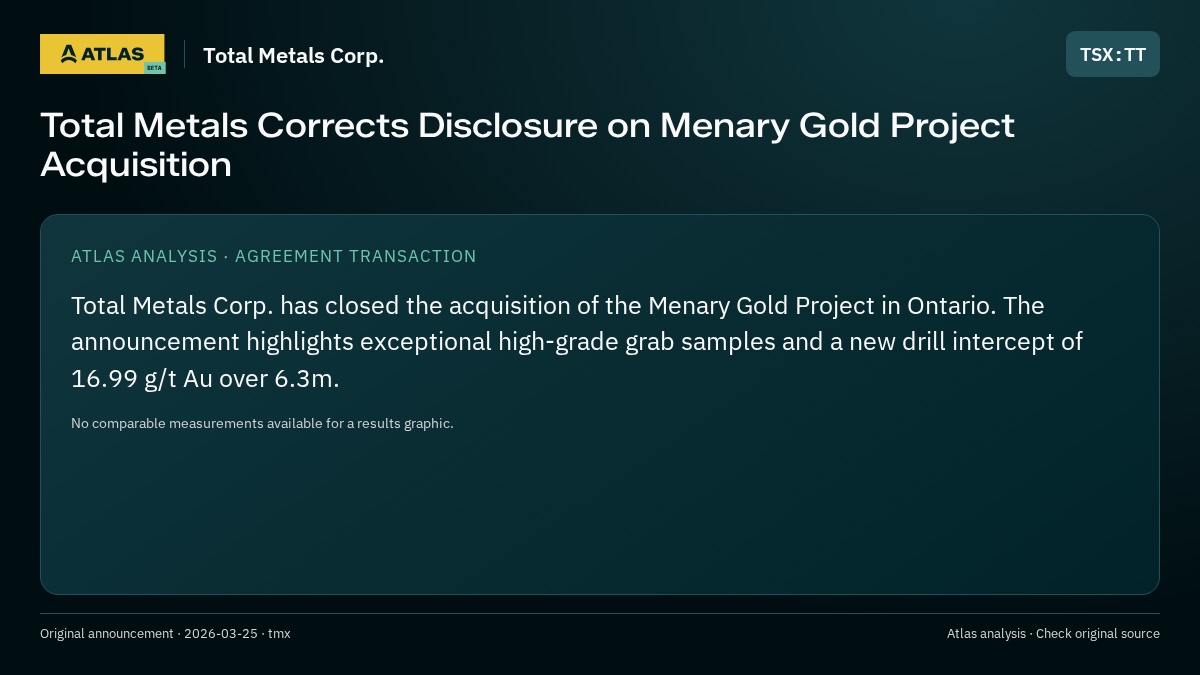
Total Metals Corp. has closed the acquisition of the Menary Gold Project in Ontario. The announcement highlights exceptional high-grade grab samples and a new drill intercept of 16.99 g/t Au over 6.3m.
Reasoning: The company has closed an acquisition of a gold project with high-grade surface samples and new drill intercepts, providing significant district-scale potential.
Positive factors
- Acquisition of Menary Gold Project completed
- High-grade grab and channel samples reported
- New mineralized zone identified via drilling
- Strategic location near major mining activity
Negative factors
- Transaction involves significant share issuance and cash payments over 4 years
- Subject to 4.5% NSR
Facts used in scoring: 6
Classification and evidence
QA/QC Disclosedpositive
Release includes QA/QC disclosure — certified lab, QP sign-off, or stated methods (blanks, standards, duplicates).
Why it applies: Qualified Person Robert Penczak, M.Sc., P.Geo (Ontario) has reviewed and approved the technical information.
Evidence · text
“Qualified Person Robert Penczak, M.Sc., P.Geo (Ontario)... has reviewed and approved the scientific and technical information”
Bonanza Interceptpositive
Exceptionally high-grade zone, well above the deposit-type norm.
Why it applies: Grab samples returned grades as high as 8,120 g/t Au.
Evidence · text
“8,120 g/t Au”
Extracted facts
Stored fact records: 0. Some facts used in scoring do not have a stored record.
No stored fact records are available for this extraction.
How Atlas produces this analysis
Minestarters Atlas uses automated extraction to summarize mining announcements, identify reported measurements, and classify supporting evidence. Sentiment reflects the extracted narrative and classification rules; it is an interpretation, not a reported measurement. Evidence quotes and context are provided where available. Missing data, low-confidence results, and review flags indicate limitations. Check the original publisher announcement before relying on an interpretation.