
TMC USA Files First Consolidated Deep-Seabed Mining Application, Increasing Expected Commercial Recovery Permit Area to 65,000 km2
Original announcement by yahoo_press on
- Company
- Unavailable
- Ticker
- TMC
- Exchange
- NYSE
- Region
- Unavailable
- Primary commodity
- Unavailable
- Secondary commodities
- None reported
- Document categories
- Permitting, Resource update
- Extracted
- 2026-08-21 02:56:52 UTC
Analysis by Minestarters Atlas
Minestarters Atlas analysis
Summary
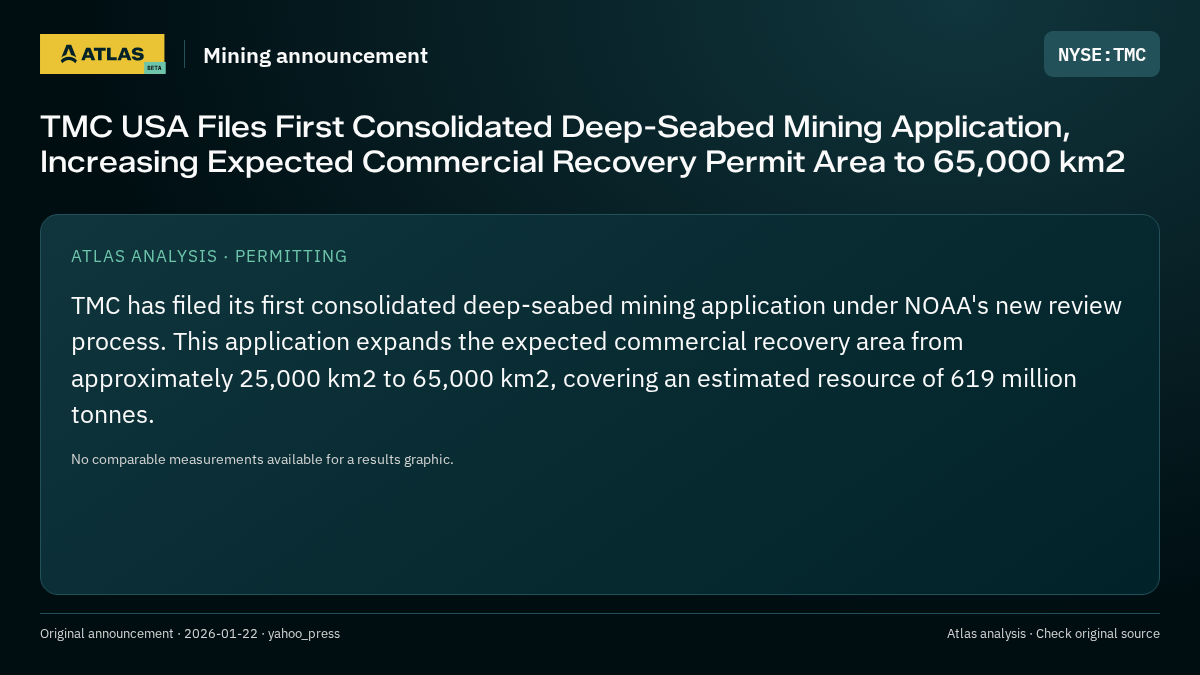
TMC has filed its first consolidated deep-seabed mining application under NOAA's new review process. This application expands the expected commercial recovery area from approximately 25,000 km2 to 65,000 km2, covering an estimated resource of 619 million tonnes.
Reasoning: The announcement of a first-of-its-kind consolidated mining application and a nearly 3x increase in the recovery area represents a major regulatory and scale milestone.
Positive factors
- First consolidated application under NOAA process
- Significant increase in commercial recovery area (25k to 65k km2)
- Large estimated resource (619 Mt)
Facts used in scoring: 1
Classification and evidence
Permitting Milestonepositive · Story-specific tag
No canonical definition is currently available.
Why it applies: Filing of the first consolidated deep-seabed mining application under NOAA's process.
Evidence · text
“First application under NOAA's consolidated application and review process.”
Extracted facts
Stored fact records: 0. Some facts used in scoring do not have a stored record.
No stored fact records are available for this extraction.
How Atlas produces this analysis
Minestarters Atlas uses automated extraction to summarize mining announcements, identify reported measurements, and classify supporting evidence. Sentiment reflects the extracted narrative and classification rules; it is an interpretation, not a reported measurement. Evidence quotes and context are provided where available. Missing data, low-confidence results, and review flags indicate limitations. Check the original publisher announcement before relying on an interpretation.