
Titan Mining Validates Kilbourne Graphite Concentrator Flowsheet and Achieves Battery-Grade Purity
Original announcement by tmx on
- Company
- Titan Mining Corporation
- Ticker
- TI
- Exchange
- TSX
- Region
- New York
- Primary commodity
- Graphite
- Secondary commodities
- Zinc
- Document categories
- Metallurgy
- Extracted
- 2026-08-22 14:38:10 UTC
Analysis by Minestarters Atlas
Minestarters Atlas analysis
Summary
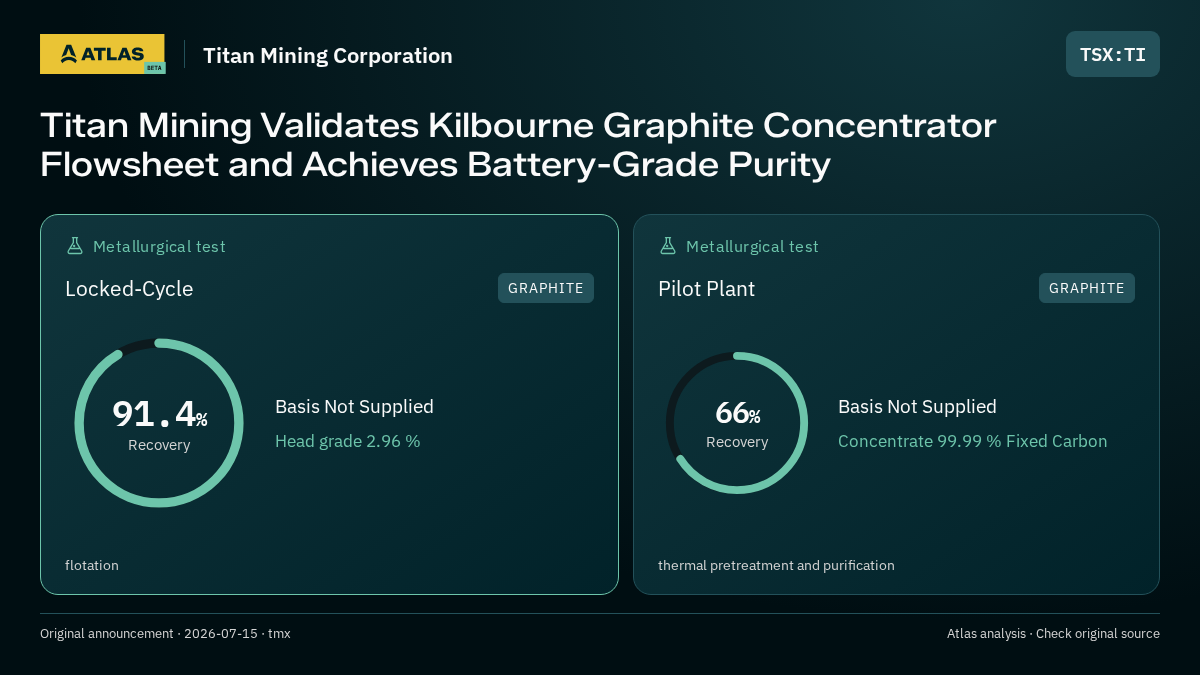
Titan Mining has successfully validated its Kilbourne Graphite Project flowsheet through locked-cycle flotation testing, producing a 95.9% C(t) concentrate at 91.4% recovery. The results also demonstrate the ability to produce battery-grade spherical graphite with 99.99% Fixed Carbon at yields exceeding industry averages.
Reasoning: The metallurgical results validate the concentrator flowsheet and downstream purification process, achieving superior grades and yields compared to both design assumptions and industry benchmarks.
Positive factors
- Exceeded PEA design basis for both grade and recovery
- Achieved battery-grade purity (99.99% Fixed Carbon)
- Spherical graphite yield (66%) significantly above industry average (50%)
- QA/QC disclosed with independent lab (SGS) and QP sign-off
Facts used in scoring: 2
Classification and evidence
High Recoverypositive
Recovery at or above the exceptional band for the commodity and processing route.
Why it applies: 91.4% recovery in flotation exceeds the strong band for graphite.
Evidence · text
“91.4% graphite recovery”
QA/QC Disclosedpositive · Story-specific tag
Release includes QA/QC disclosure — certified lab, QP sign-off, or stated methods (blanks, standards, duplicates).
Why it applies: Release mentions SGS Lakefield, QP sign-off, and specific QA/QC methods.
Evidence · text
“The metallurgical testwork program was conducted under a quality assurance and quality control ("QA/QC") program designed by SGS Lakefield”
Mill Routeneutral
Processing via mill or concentrator (CIL, CIP, tank leach, flotation).
Why it applies: Testing involved flotation and comminution.
Evidence · text
“The test program included comminution testing and laboratory flotation testing.”
Extracted facts
Stored fact records: 2. Some facts used in scoring do not have a stored record.
Metallurgical Results (2)
locked-cyclegraphiteRecovery: 91.4 %Head Grade: 2.96Head Grade Unit: %View all detailsHide details
Identity
- Commodity
- graphite
- Ticker
- TI
Test Work
- Program Status
- detailed
- Test Type
- locked-cycle
- Processing Route
- flotation
- Sample
- 11th Cleaner Concentrate (Locked Cycle Flotation)
Recovery
- Recovery
- 91.4 %
- Head Grade
- 2.96
- Head Grade Unit
- %
- Conc. Grade
- 95.9
- Conc. Grade Unit
- %
Lab
- Laboratory
- SGS
Review
- Needs Review
- No
- Historical
- No
Dates
- Event date
- 2026-07-15T00:00:00.000Z
Reasoning: High recovery and grade achieved in locked-cycle testing.
Positive factors
- Exceeds PEA design basis of 95% grade and 90% recovery
Evidence · table
“95.9”
Context: 2.81
pilot plantgraphiteRecovery: 66 %View all detailsHide details
Identity
- Commodity
- graphite
- Ticker
- TI
Test Work
- Program Status
- detailed
- Test Type
- pilot plant
- Processing Route
- thermal pretreatment and purification
- Sample
- Spherical Purified Graphite (SPG)
Recovery
- Recovery
- 66 %
- Conc. Grade
- 99.99
- Conc. Grade Unit
- % Fixed Carbon
Review
- Needs Review
- No
- Historical
- No
Dates
- Event date
- 2026-07-15T00:00:00.000Z
Reasoning: Demonstrates high-value product capability and superior yields.
Positive factors
- Achieved battery-grade purity
- Yield (66%) is significantly above industry average (50%)
Evidence · text
“99.99% Fixed Carbon for spherical purified graphite (SPG)”
How Atlas produces this analysis
Minestarters Atlas uses automated extraction to summarize mining announcements, identify reported measurements, and classify supporting evidence. Sentiment reflects the extracted narrative and classification rules; it is an interpretation, not a reported measurement. Evidence quotes and context are provided where available. Missing data, low-confidence results, and review flags indicate limitations. Check the original publisher announcement before relying on an interpretation.