
TINONE ANNOUNCES INITIAL MINERAL RESOURCE ESTIMATE FOR THE GREAT PYRAMID PROJECT, TASMANIA, AUSTRALIA
Original announcement by tmx on
- Company
- TinOne Resources Inc.
- Ticker
- TORC
- Exchange
- TSX
- Region
- Tasmania, Australia
- Primary commodity
- Tin
- Secondary commodities
- None reported
- Document categories
- Resource update
- Extracted
- 2026-08-21 11:10:51 UTC
Analysis by Minestarters Atlas
Minestarters Atlas analysis
Summary
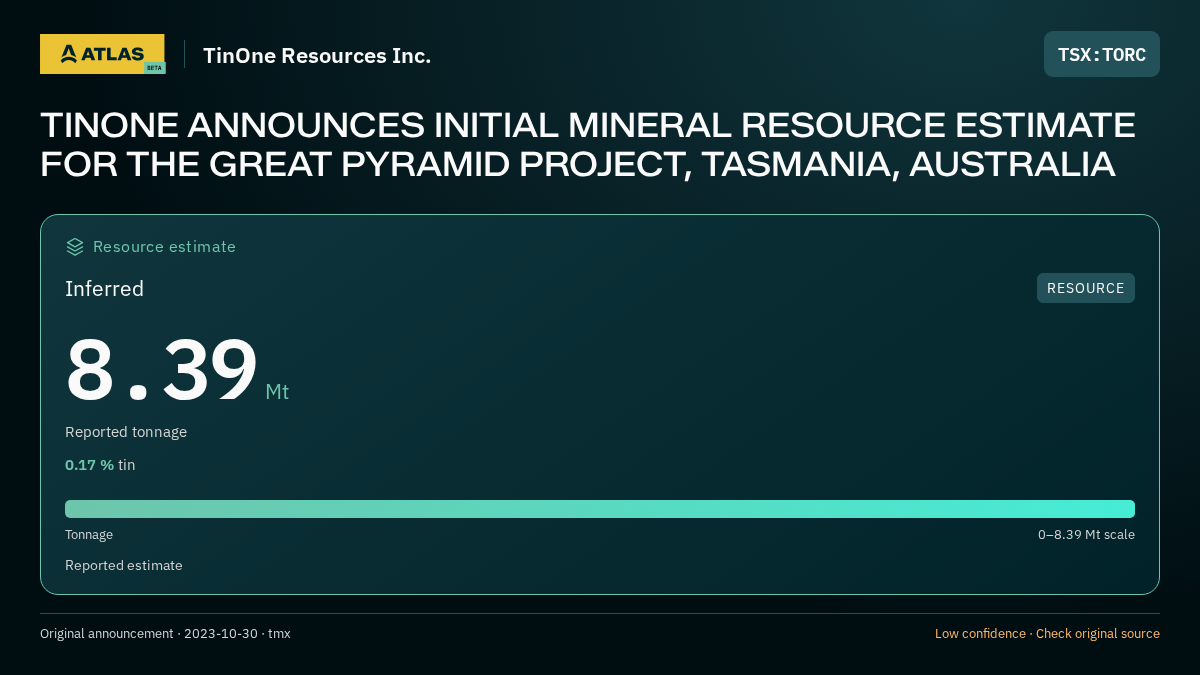
TinOne Resources has announced its maiden inferred mineral resource estimate for the Great Pyramid tin project in Tasmania, totaling 8.39 million tonnes at 0.17% tin. The resource outlines 14.4 thousand tonnes of contained tin and suggests significant expansion potential at depth.
Reasoning: The announcement of a maiden mineral resource estimate for the Great Pyramid Project provides a new baseline for the asset, though the high proportion of Inferred material and reliance on older metallurgical data limits immediate bankability.
Positive factors
- Maiden resource estimate establishes baseline
- Significant increase in contained tin vs historical estimate
- Low implied strip ratio of 1.12:1
- Open at depth with expansion potential
Negative factors
- 100% Inferred category limits economic confidence
- Based on preliminary test work from 1980s
- Historical percussion drilling rejected due to quality concerns
Low confidence — this extraction should be reviewed alongside the original source.
Facts used in scoring: 1
Classification and evidence
Maiden Resourceneutral
First formal MRE for the project — establishes baseline but typically exploration-stage with high Inferred component.
Why it applies: The company describes this as its 'initial mineral resource estimate' and 'maiden mineral resource estimate'.
Evidence · text
“initial mineral resource estimate”
Inferred Resourcenegative
Speculative category — limited drilling, geological continuity assumed but not confirmed. Cannot support economic studies alone.
Why it applies: The entire resource is classified as Inferred.
Evidence · table
“Inferred”
Context: 8.39
NI 43-101 Compliantpositive
Resource estimate prepared in compliance with NI 43-101 (Canada) — high reporting standard.
Why it applies: The MRE was prepared in accordance with NI 43-101 Standards.
Evidence · text
“in accordance with National Instrument 43-101 Standards”
QP/CP Signedpositive
Qualified Person (QP) or Competent Person (CP) named and signed off — a member of a recognized professional association (e.g., AusIMM, SME, AIG, P.Geo) with relevant experience.
Why it applies: Russell Fulton and Ian Taylor are named as Qualified Persons who reviewed and approved the disclosure.
Evidence · text
“reviewed and approved by Russell Fulton (MAIG)... and Mr. Ian Taylor”
Cut-off Disclosedpositive
Cut-off grade used for resource reporting is clearly stated, enabling like-for-like comparison.
Why it applies: The cut-off grade of 0.10% Sn is explicitly stated in the resource table.
Evidence · table
“> 0.10”
Context: 8.39
Extracted facts
Stored fact records: 1. Some facts used in scoring do not have a stored record.
Resource Estimates (1)
inferredtinTonnes: 8390000Grade: 0.17Grade Unit: %Contained Metal: 14400Contained Unit: ktView all detailsHide details
Identity
- Commodity
- tin
- Ticker
- TORC
Resource Data
- Category
- inferred
- Tonnes
- 8390000
- Grade
- 0.17
- Grade Unit
- %
- Contained Metal
- 14400
- Contained Unit
- kt
- Cutoff Grade
- 0.1
Review
- Needs Review
- No
- Historical
- No
Dates
- Event date
- 2023-10-30T00:00:00.000Z
Reasoning: Maiden resource of 8.4Mt at 0.17% Sn provides a significant new baseline for the project.
Positive factors
- Maiden resource
Negative factors
- All inferred
Evidence · table
“0.17”
Context: 8.39
How Atlas produces this analysis
Minestarters Atlas uses automated extraction to summarize mining announcements, identify reported measurements, and classify supporting evidence. Sentiment reflects the extracted narrative and classification rules; it is an interpretation, not a reported measurement. Evidence quotes and context are provided where available. Missing data, low-confidence results, and review flags indicate limitations. Check the original publisher announcement before relying on an interpretation.