
Tearlach Resources announces strong results from channel sampling program at Georgina Properties
Original announcement by tmx on
- Company
- Tearlach Resources
- Ticker
- TEA
- Exchange
- TSX
- Region
- Ontario
- Primary commodity
- Lithium
- Secondary commodities
- None reported
- Document categories
- Drill results, Other
- Extracted
- 2026-08-21 11:05:55 UTC
Analysis by Minestarters Atlas
Minestarters Atlas analysis
Summary
Tearlach Resources reported high-grade lithium oxide results from grab and channel sampling at its Georgina Properties in Ontario. The mineralization at Parks Lake extends over a 2.6 km strike length, and the company has applied for a maiden drill permit.
Reasoning: High-grade Li2O grab and channel samples reported at the Georgina Properties, following a recent spodumene discovery.
Positive factors
- high-grade lithium oxide intercepts
- strike length extension
Facts used in scoring: 4
Classification and evidence
QA/QC Disclosedpositive
Release includes QA/QC disclosure — certified lab, QP sign-off, or stated methods (blanks, standards, duplicates).
Why it applies: The release mentions assay results but does not explicitly detail QA/QC protocols or lab certification.
Evidence · text
“recent assay results from the company's channel sampling program”
No QA/QC Disclosurenegative
Release does not disclose QA/QC — lab certification, CP/QP sign-off and assay protocols cannot be checked from this document.
Why it applies: The release lacks specific mention of certified labs, standards, or blanks used in the assaying process.
Evidence · text
“recent assay results from the company's channel sampling program”
Extracted facts
Stored fact records: 4. Some facts used in scoring do not have a stored record.
Drill Results (4)
Fact 1lithiumGrade: 6.48Grade Unit: % Li2OView all detailsHide details
Identity
- Commodity
- lithium
- Ticker
- TEA
Geometry
- Grade
- 6.48
- Grade Unit
- % Li2O
Classification
- Sample Type
- surface
Review
- Needs Review
- No
- Interp. Status
- scored
- Historical
- No
Dates
- Event date
- 2023-11-29T00:00:00.000Z
Reasoning: 6.48% Li2O is an exceptional grade for lithium.
Positive factors
- exceptional grade
Evidence · text
“6.48% from a blue-grey spodumene sample”
Fact 2lithiumGrade: 5.89Grade Unit: % Li2OView all detailsHide details
Identity
- Commodity
- lithium
- Ticker
- TEA
Geometry
- Grade
- 5.89
- Grade Unit
- % Li2O
Classification
- Sample Type
- surface
Review
- Needs Review
- No
- Interp. Status
- scored
- Historical
- No
Dates
- Event date
- 2023-11-29T00:00:00.000Z
Reasoning: 5.89% Li2O is an exceptional grade for lithium.
Positive factors
- exceptional grade
Evidence · text
“5.89% from a green spodumene sample”
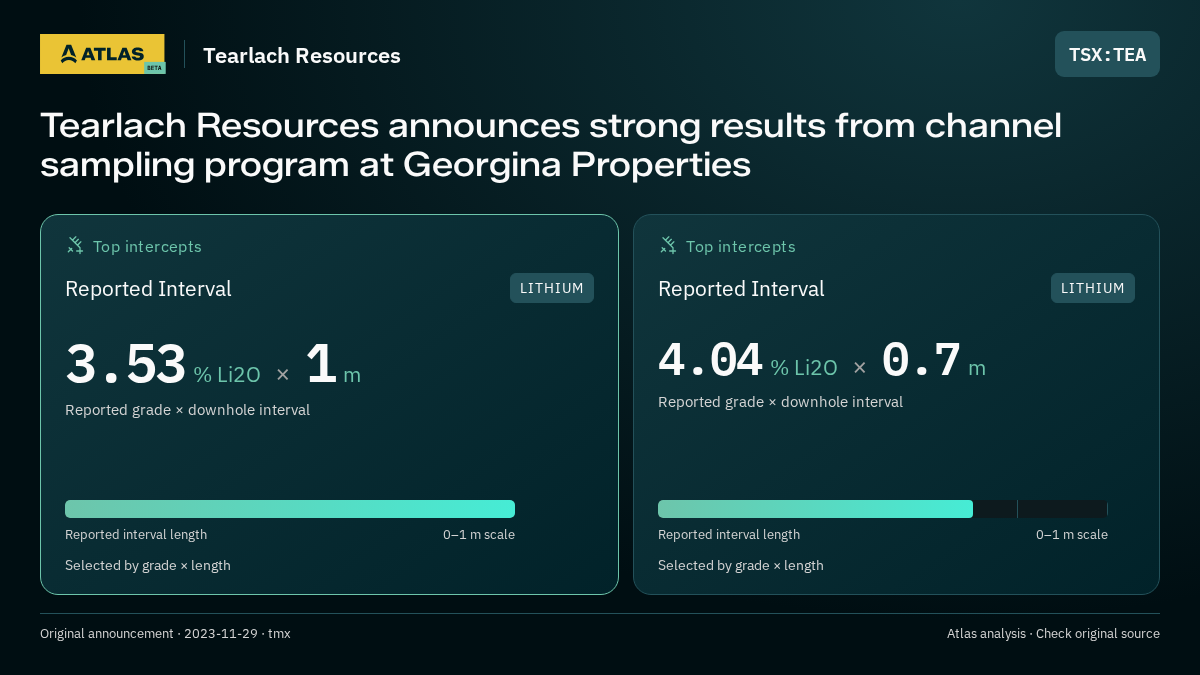
Fact 3lithiumGrade: 4.04Grade Unit: % Li2OIntercept: 0.7 mView all detailsHide details
Identity
- Commodity
- lithium
- Ticker
- TEA
Geometry
- Grade
- 4.04
- Grade Unit
- % Li2O
- Intercept
- 0.7 m
Classification
- Sample Type
- channel
Review
- Needs Review
- No
- Interp. Status
- scored
- Historical
- No
Dates
- Event date
- 2023-11-29T00:00:00.000Z
Reasoning: 4.04% Li2O is a strong grade for lithium.
Positive factors
- strong grade
Evidence · text
“4.04% Li2O over 0.70 meters from the inner core zone”
Fact 4lithiumGrade: 3.53Grade Unit: % Li2OIntercept: 1 mView all detailsHide details
Identity
- Commodity
- lithium
- Ticker
- TEA
Geometry
- Grade
- 3.53
- Grade Unit
- % Li2O
- Intercept
- 1 m
Classification
- Sample Type
- channel
Review
- Needs Review
- No
- Interp. Status
- scored
- Historical
- No
Dates
- Event date
- 2023-11-29T00:00:00.000Z
Reasoning: 3.53% Li2O is a moderate grade for lithium.
Positive factors
- moderate grade
Evidence · text
“3.53% Li2O over 1.0 meter from the blue spodumene zone”
How Atlas produces this analysis
Minestarters Atlas uses automated extraction to summarize mining announcements, identify reported measurements, and classify supporting evidence. Sentiment reflects the extracted narrative and classification rules; it is an interpretation, not a reported measurement. Evidence quotes and context are provided where available. Missing data, low-confidence results, and review flags indicate limitations. Check the original publisher announcement before relying on an interpretation.