
Scottie Resources Advances Direct-Ship Ore Strategy with Phase 2 Ore Sorting Study Success and Feasibility Study Launch
Original announcement by tmx on
- Company
- Scottie Resources Corp.
- Ticker
- SCOT
- Exchange
- TSX
- Region
- British Columbia
- Primary commodity
- Gold
- Secondary commodities
- None reported
- Document categories
- Metallurgy, Resource update
- Extracted
- 2026-08-22 10:53:29 UTC
Analysis by Minestarters Atlas
Minestarters Atlas analysis
Summary
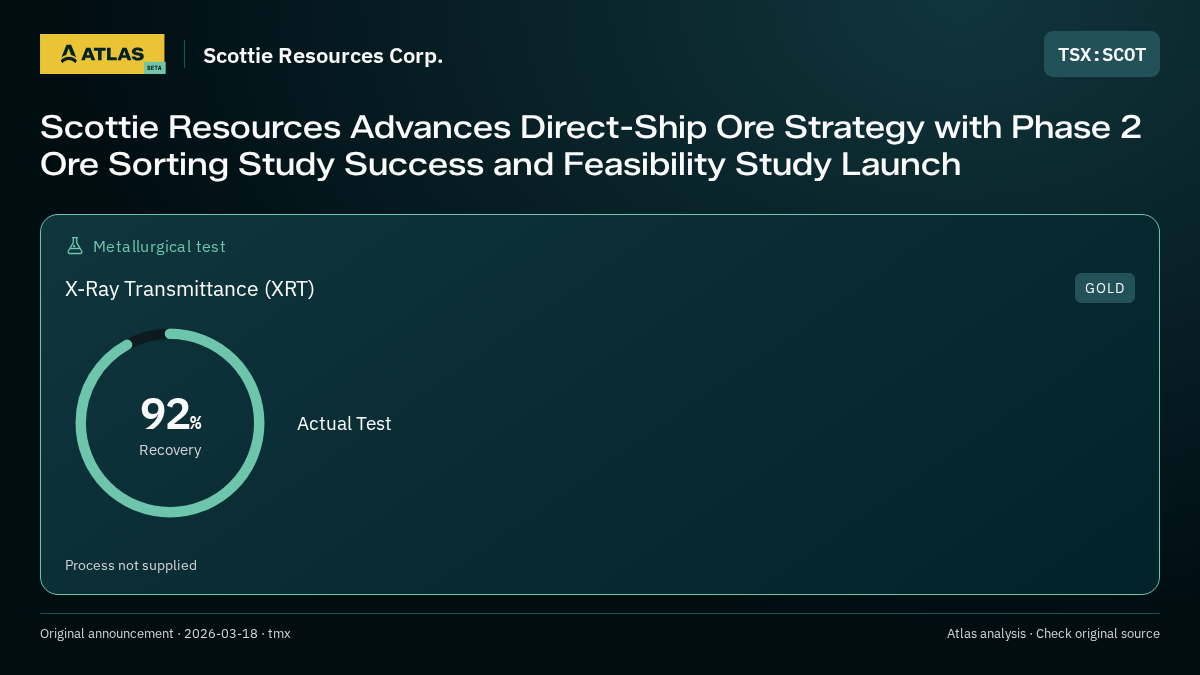
Scottie Resources has successfully completed its Phase 2 Ore Sorting Study, confirming high gold recoveries of 82% to 92% using X-Ray Transmittance (XRT) technology. Following these results, the company is launching a Feasibility Study to evaluate a high-margin Direct-Ship Ore (DSO) operation at the Scottie Gold Mine Project.
Reasoning: The successful Phase 2 ore sorting study provides high confidence in the Direct-Ship Ore (DSO) strategy, which significantly de-risks the project economics by potentially eliminating the need for a conventional mill.
Positive factors
- Successful Phase 2 ore sorting study
- High gold recovery (82-92%) via XRT
- Launch of Feasibility Study
- DSO strategy reduces CAPEX and environmental footprint
Negative factors
- Resource is currently 100% Inferred
Facts used in scoring: 2
Classification and evidence
High Recoverypositive
Recovery at or above the exceptional band for the commodity and processing route.
Why it applies: XRT recovery of 82% to 92% is very strong for ore sorting technology.
Evidence · text
“XRT sorter can recover 82% to 92% of the gold”
All Inferrednegative
100% of resource is Inferred category — very early stage, no engineering confidence.
Why it applies: The reported resource is 100% in the Inferred category.
Evidence · text
“703,000 gold ounces at an average grade of 6.1 g/t (Inferred category)”
QP/CP Signedpositive
Qualified Person (QP) or Competent Person (CP) named and signed off — a member of a recognized professional association (e.g., AusIMM, SME, AIG, P.Geo) with relevant experience.
Why it applies: Dr. Thomas Mumford, P.Geo., a qualified person, has reviewed and approved the technical information.
Evidence · text
“Dr. Thomas Mumford, P.Geo... a qualified person under National Instrument 43-101, has reviewed and approved”
Extracted facts
Stored fact records: 2. Some facts used in scoring do not have a stored record.
Metallurgical Results (2)
X-Ray Transmittance (XRT)goldRecovery: 92 %View all detailsHide details
Identity
- Commodity
- gold
- Ticker
- SCOT
Test Work
- Program Status
- detailed
- Test Type
- X-Ray Transmittance (XRT)
- Sample
- XRT Phase 2 test on representative bulk sample
Recovery
- Recovery
- 92 %
- Recovery Basis
- actual_test
Review
- Needs Review
- No
- Historical
- No
Dates
- Event date
- 2026-03-18T00:00:00.000Z
Reasoning: The upper bound of 92% recovery via XRT is exceptional for an ore sorting application.
Positive factors
- High recovery range (82-92%)
Evidence · text
“XRT Phase 2 test... show that the XRT sorter can recover 82% to 92% of the gold”
Fact 2goldView all detailsHide details
Identity
- Commodity
- gold
- Ticker
- SCOT
Review
- Needs Review
- No
- Historical
- No
Dates
- Event date
- 2026-03-18T00:00:00.000Z
Reasoning: While the grade is high, the entire resource is currently in the Inferred category, representing high geological risk.
Positive factors
- High grade (6.1 g/t Au)
Negative factors
- 100% Inferred category
Evidence · text
“total of 703,000 gold ounces at an average grade of 6.1 g/t (Inferred category) in 3.6 millon tonnes”
How Atlas produces this analysis
Minestarters Atlas uses automated extraction to summarize mining announcements, identify reported measurements, and classify supporting evidence. Sentiment reflects the extracted narrative and classification rules; it is an interpretation, not a reported measurement. Evidence quotes and context are provided where available. Missing data, low-confidence results, and review flags indicate limitations. Check the original publisher announcement before relying on an interpretation.