
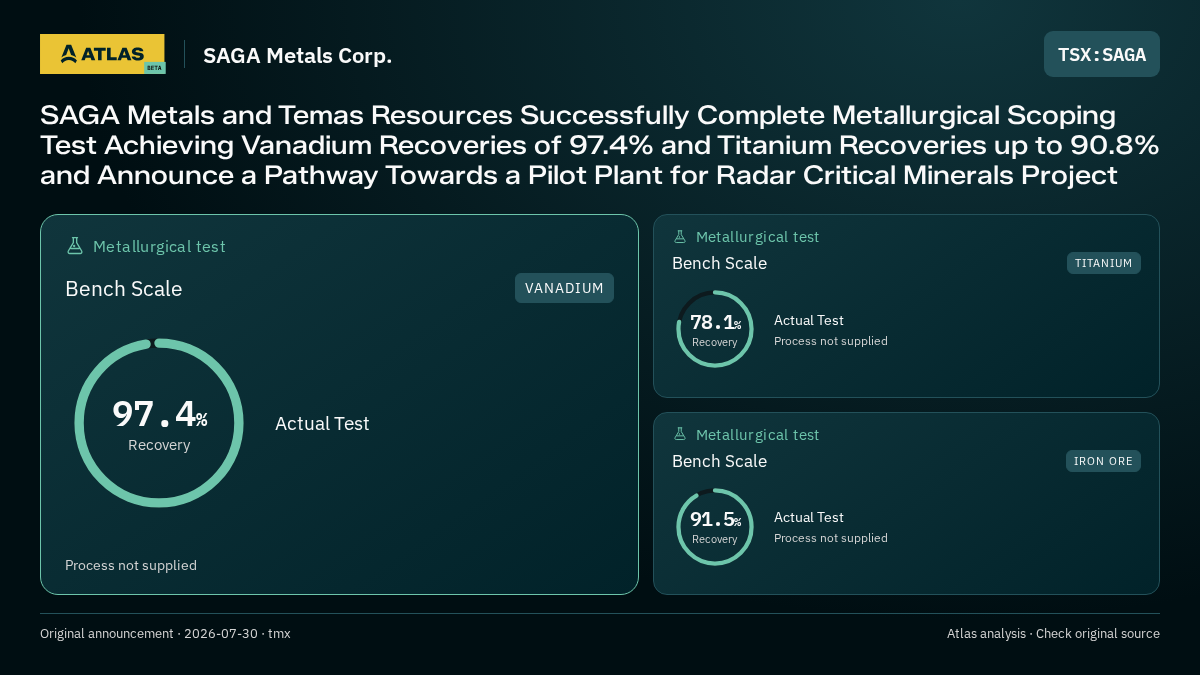
SAGA Metals and Temas Resources Successfully Complete Metallurgical Scoping Test Achieving Vanadium Recoveries of 97.4% and Titanium Recoveries up to 90.8% and Announce a Pathway Towards a Pilot Plant for Radar Critical Minerals Project
Original announcement by tmx on
- Company
- SAGA Metals Corp.
- Ticker
- SAGA
- Exchange
- TSX
- Region
- Labrador, Canada
- Primary commodity
- Vanadium
- Secondary commodities
- Titanium, Iron ore
- Document categories
- Metallurgy, Drill results
- Extracted
- 2026-08-20 19:17:54 UTC
Analysis by Minestarters Atlas
Minestarters Atlas analysis
Summary
SAGA Metals has successfully completed Stage 1 metallurgical scoping tests at its Radar Project using Temas Resources' RCL technology, achieving vanadium recoveries of 97.4% and titanium recoveries up to 90.8%. The results support advancing to a Stage 2 Detailed Bench Optimization Program and a future pathway toward pilot plant demonstration.
Reasoning: The announcement reports highly successful Stage 1 metallurgical scoping results using proprietary RCL technology, showing exceptional recoveries for vanadium and titanium, which significantly de-risks the project's commercial potential.
Positive factors
- High vanadium recoveries (97.4%)
- Strong titanium recoveries (up to 90.8%)
- Successful bench-scale validation
- Pathway to pilot plant established
Facts used in scoring: 9
Classification and evidence
QA/QC Disclosedpositive
Release includes QA/QC disclosure — certified lab, QP sign-off, or stated methods (blanks, standards, duplicates).
Why it applies: The release mentions standard protocols for RCL validation and independent technical review.
Evidence · text
“standard protocols for RCL Validation”
True Width Disclosedpositive
Actual thickness perpendicular to structure is stated, not just downhole length.
Why it applies: The drill intercept table explicitly provides a 'True Thickness' column.
Evidence · table
“True Thickness”
Context: DDH ID
Extracted facts
Stored fact records: 9. Some facts used in scoring do not have a stored record.
Metallurgical Results (9)
bench scalevanadiumRecovery: 97.4 %View all detailsHide details
Identity
- Commodity
- vanadium
- Ticker
- SAGA
Test Work
- Program Status
- scoping
- Test Type
- bench scale
- Sample
- ROM Massive Oxide
Recovery
- Recovery
- 97.4 %
- Recovery Basis
- actual_test
Review
- Needs Review
- No
- Historical
- No
Dates
- Event date
- 2026-07-30T00:00:00.000Z
Reasoning: 97.4% recovery is exceptional for vanadium.
Positive factors
- Exceptional recovery
Evidence · table
“97.40%”
Context: ROM Massive Oxide
bench scaletitaniumRecovery: 78.1 %View all detailsHide details
Identity
- Commodity
- titanium
- Ticker
- SAGA
Test Work
- Program Status
- scoping
- Test Type
- bench scale
- Sample
- ROM Massive Oxide
Recovery
- Recovery
- 78.1 %
- Recovery Basis
- actual_test
Review
- Needs Review
- No
- Historical
- No
Dates
- Event date
- 2026-07-30T00:00:00.000Z
Reasoning: 78.1% recovery is moderate for titanium.
Evidence · table
“78.10%”
Context: ROM Massive Oxide
bench scaleiron_oreRecovery: 91.5 %View all detailsHide details
Identity
- Commodity
- iron_ore
- Ticker
- SAGA
Test Work
- Program Status
- scoping
- Test Type
- bench scale
- Sample
- ROM Massive Oxide
Recovery
- Recovery
- 91.5 %
- Recovery Basis
- actual_test
Review
- Needs Review
- No
- Historical
- No
Dates
- Event date
- 2026-07-30T00:00:00.000Z
Reasoning: 91.5% recovery is strong for iron.
Evidence · table
“91.50%”
Context: ROM Massive Oxide
bench scalevanadiumRecovery: 97.4 %View all detailsHide details
Identity
- Commodity
- vanadium
- Ticker
- SAGA
Test Work
- Program Status
- scoping
- Test Type
- bench scale
- Sample
- Ilmenite Concentrate
Recovery
- Recovery
- 97.4 %
- Recovery Basis
- actual_test
Review
- Needs Review
- No
- Historical
- No
Dates
- Event date
- 2026-07-30T00:00:00.000Z
Reasoning: 97.4% recovery is exceptional for vanadium.
Positive factors
- Exceptional recovery
Evidence · table
“97.40%”
Context: Ilmenite Concentrate
bench scaletitaniumRecovery: 90.8 %View all detailsHide details
Identity
- Commodity
- titanium
- Ticker
- SAGA
Test Work
- Program Status
- scoping
- Test Type
- bench scale
- Sample
- Ilmenite Concentrate
Recovery
- Recovery
- 90.8 %
- Recovery Basis
- actual_test
Review
- Needs Review
- No
- Historical
- No
Dates
- Event date
- 2026-07-30T00:00:00.000Z
Reasoning: 90.8% recovery is strong for titanium.
Positive factors
- Strong recovery
Evidence · table
“90.80%”
Context: Ilmenite Concentrate
bench scaleiron_oreRecovery: 86.7 %View all detailsHide details
Identity
- Commodity
- iron_ore
- Ticker
- SAGA
Test Work
- Program Status
- scoping
- Test Type
- bench scale
- Sample
- Ilmenite Concentrate
Recovery
- Recovery
- 86.7 %
- Recovery Basis
- actual_test
Review
- Needs Review
- No
- Historical
- No
Dates
- Event date
- 2026-07-30T00:00:00.000Z
Reasoning: 86.7% recovery is strong for iron.
Evidence · table
“86.70%”
Context: Ilmenite Concentrate
Fact 7vanadiumView all detailsHide details
Identity
- Commodity
- vanadium
- Ticker
- SAGA
Review
- Needs Review
- No
- Historical
- No
Dates
- Event date
- 2026-07-30T00:00:00.000Z
Reasoning: 0.339% V2O5 is a standard grade for this deposit type.
Evidence · table
“0.339”
Context: 87.2
Fact 8titaniumView all detailsHide details
Identity
- Commodity
- titanium
- Ticker
- SAGA
Review
- Needs Review
- No
- Historical
- No
Dates
- Event date
- 2026-07-30T00:00:00.000Z
Reasoning: 10.15% TiO2 is a strong grade.
Evidence · table
“10.15”
Context: 87.2
Fact 9iron_oreView all detailsHide details
Identity
- Commodity
- iron_ore
- Ticker
- SAGA
Review
- Needs Review
- No
- Historical
- No
Dates
- Event date
- 2026-07-30T00:00:00.000Z
Reasoning: 50.67% Fe2O3 is a moderate grade.
Evidence · table
“50.67”
Context: 87.2
How Atlas produces this analysis
Minestarters Atlas uses automated extraction to summarize mining announcements, identify reported measurements, and classify supporting evidence. Sentiment reflects the extracted narrative and classification rules; it is an interpretation, not a reported measurement. Evidence quotes and context are provided where available. Missing data, low-confidence results, and review flags indicate limitations. Check the original publisher announcement before relying on an interpretation.