
Nearly 3 Million Ounces of Century-Old Silver. Ontario Just Opened the Door.
Original announcement by tmx on
- Company
- Nord Precious Metals Mining Inc.
- Ticker
- NTH
- Exchange
- TSX
- Region
- Ontario
- Primary commodity
- Silver
- Secondary commodities
- Gold, Cobalt, Nickel, Lithium
- Document categories
- Resource update, Permitting
- Extracted
- 2026-08-20 17:17:52 UTC
Analysis by Minestarters Atlas
Minestarters Atlas analysis
Summary
Nord Precious Metals has entered pre-submission consultation with Ontario's environment ministry regarding its Gowganda silver tailings recovery program. The company also recently converted a $3 million receivable into a 3% gold royalty on a Quebec property to clean up its balance sheet.
Reasoning: The document discusses a permitting milestone and a debt conversion, but the primary silver resource mentioned is a historical, non-current estimate that the company explicitly states it is not treating as a current resource.
Positive factors
- Permitting pathway initiated with MECP
- Low-CAPEX tailings recovery model
- Debt-to-royalty conversion improves balance sheet
Negative factors
- Resource is historical and non-compliant with current standards
- Resource is not being treated as a current mineral resource by the company
- Regulatory approval is still pending
Low confidence — this extraction should be reviewed alongside the original source.
Facts used in scoring: 1
Classification and evidence
Historical Estimate Onlynegative
Estimate pre-dates or does not comply with current JORC/NI 43-101 standards — requires verification drilling.
Why it applies: The silver resource is a 2011 estimate that the company states is non-current and not being treated as a current mineral resource.
Evidence · text
“Nord characterizes this as a historical estimate only — a qualified person has not done sufficient work to classify it as a current mineral resource, and the Company is not treating it as one.”
Inferred Resourcenegative
Speculative category — limited drilling, geological continuity assumed but not confirmed. Cannot support economic studies alone.
Why it applies: The document notes the resource is historical and lacks current classification, though it uses the term 'indicated' for the 2011 data, the company's disclaimer treats it as speculative.
Evidence · text
“The Castle East silver resource and the tailings resource referenced are described by the company as historical estimates; a qualified person has not done sufficient work to classify them as current mineral resources”
Extracted facts
Stored fact records: 1. Some facts used in scoring do not have a stored record.
Resource Estimates (1)
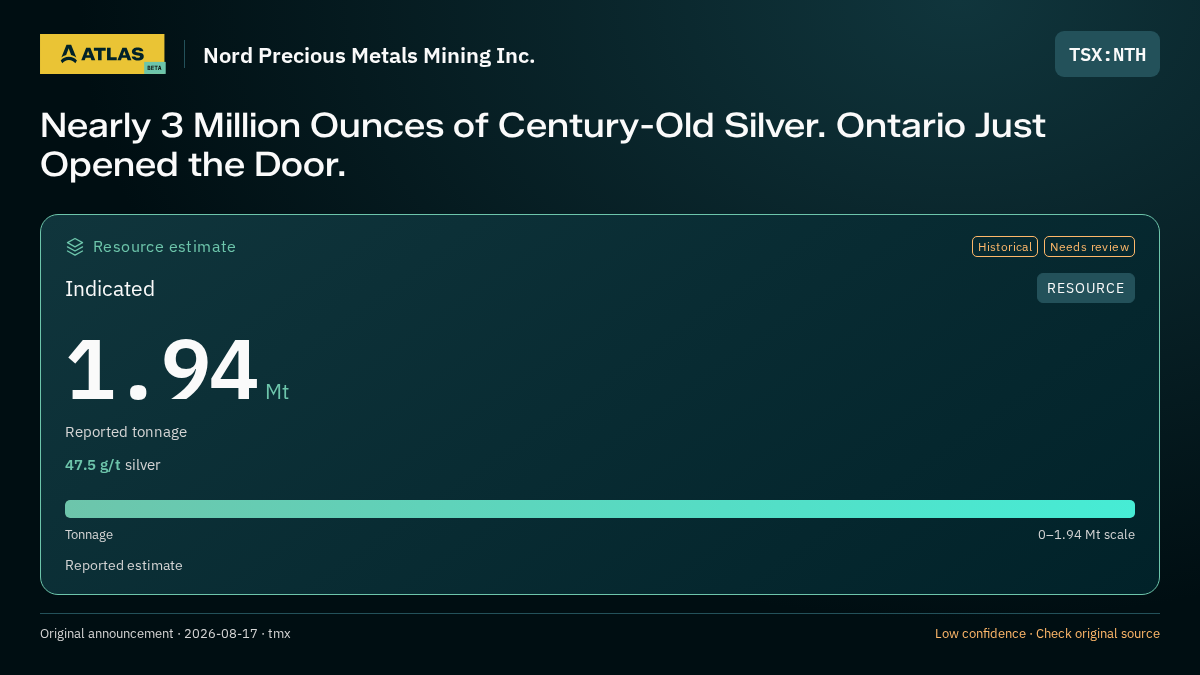
indicatedsilverTonnes: 1940000Grade: 47.5Grade Unit: g/tContained Metal: 2960000Contained Unit: ozHistorical resultNeeds review: historical_restatementView all detailsHide details
Identity
- Commodity
- silver
- Ticker
- NTH
Resource Data
- Category
- indicated
- Tonnes
- 1940000
- Grade
- 47.5
- Grade Unit
- g/t
- Contained Metal
- 2960000
- Contained Unit
- oz
Review
- Needs Review
- Yes
- Review Reason
- historical_restatement
- Historical
- Yes
- Historical Source Date
- 2011-01-01T00:00:00.000Z
Dates
- Event date
- 2026-08-17T00:00:00.000Z
Reasoning: The 47.5 g/t Ag grade is strong, but the data is a 2011 historical estimate that the company explicitly warns against relying upon as a current resource.
Positive factors
- High grade for tailings
Negative factors
- Historical estimate only
- Non-compliant with current standards
- Not treated as a current resource
Evidence · text
“The Gowganda tailings carry a historical NI 43-101 indicated estimate of approximately 1.94 million tonnes grading 47.5 g/t Ag for roughly 2.96 million contained ounces of silver”
How Atlas produces this analysis
Minestarters Atlas uses automated extraction to summarize mining announcements, identify reported measurements, and classify supporting evidence. Sentiment reflects the extracted narrative and classification rules; it is an interpretation, not a reported measurement. Evidence quotes and context are provided where available. Missing data, low-confidence results, and review flags indicate limitations. Check the original publisher announcement before relying on an interpretation.