
Market movers: Walmart, Alibaba, 1911 Gold, Sintana Energy... 14:30 20 Aug
Original announcement by proactiveinvestors on
- Company
- 1911 Gold Corp
- Ticker
- AUMB
- Exchange
- Unavailable
- Region
- Manitoba
- Primary commodity
- Gold
- Secondary commodities
- None reported
- Document categories
- Metallurgy, Drill results
- Extracted
- 2026-08-20 19:47:18 UTC
Analysis by Minestarters Atlas
Minestarters Atlas analysis
Summary
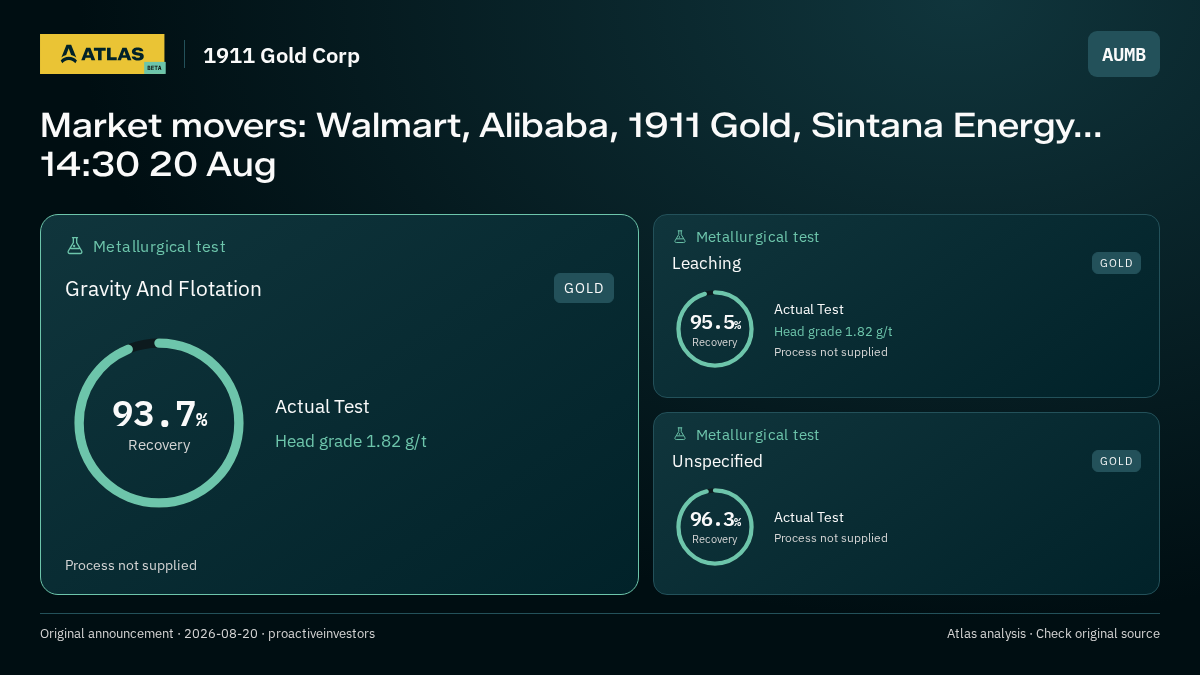
1911 Gold Corp reported successful metallurgical test results for its True North Gold Project and Ogama-Rockland Gold Project in Manitoba. Gold recoveries reached up to 96.3% across different testing stages.
Reasoning: Reported gold recoveries of 93.7% and 96.3% are strong for the commodity, supported by specific head grade and sample mass data.
Positive factors
- High gold recovery
- Multiple processing routes successful
Facts used in scoring: 3
Classification and evidence
High Recoverypositive
Recovery at or above the exceptional band for the commodity and processing route.
Why it applies: Gold recoveries of 93.7% and 96.3% are well above the strong/exceptional thresholds.
Evidence · text
“gold recoveries of 93.7% from a sample at its True North Gold Project and 96.3% from preliminary testing”
Extracted facts
Stored fact records: 3. Some facts used in scoring do not have a stored record.
Metallurgical Results (3)
gravity and flotationTrue North Gold Project · goldRecovery: 93.7 %Head Grade: 1.82Head Grade Unit: g/tView all detailsHide details
Identity
- Project
- True North Gold Project
- Commodity
- gold
- Region
- canada_mb
- Reported Region
- Manitoba
- Ticker
- AUMB
Test Work
- Program Status
- preliminary
- Test Type
- gravity and flotation
- Sample
- 130-kilogram sample from the L10 Zone on Level 16, True North Gold Project
Recovery
- Recovery
- 93.7 %
- Recovery Basis
- actual_test
- Head Grade
- 1.82
- Head Grade Unit
- g/t
Review
- Needs Review
- No
- Historical
- No
Dates
- Event date
- 2026-08-20T00:00:00.000Z
Reasoning: 93.7% recovery is strong for gold.
Positive factors
- Strong recovery
Evidence · text
“True North, the company tested a 130-kilogram sample from the L10 Zone on Level 16, with a measured head grade of 1.82 grams per tonne gold. The test work produced an average total gold recovery of 93.7%”
leachingTrue North Gold Project · goldRecovery: 95.5 %Head Grade: 1.82Head Grade Unit: g/tView all detailsHide details
Identity
- Project
- True North Gold Project
- Commodity
- gold
- Region
- canada_mb
- Reported Region
- Manitoba
- Ticker
- AUMB
Test Work
- Program Status
- preliminary
- Test Type
- leaching
- Sample
- reground flotation concentrate, True North Gold Project
Recovery
- Recovery
- 95.5 %
- Recovery Basis
- actual_test
- Head Grade
- 1.82
- Head Grade Unit
- g/t
Review
- Needs Review
- No
- Historical
- No
Dates
- Event date
- 2026-08-20T00:00:00.000Z
Reasoning: 95.5% recovery on reground concentrate is excellent.
Positive factors
- High recovery on concentrate
Evidence · text
“Leaching of the reground flotation concentrate averaged 95.5% gold recovery.”
unspecifiedOgama-Rockland Gold Project · goldRecovery: 96.3 %View all detailsHide details
Identity
- Project
- Ogama-Rockland Gold Project
- Commodity
- gold
- Region
- canada_mb
- Reported Region
- Manitoba
- Ticker
- AUMB
Test Work
- Program Status
- preliminary
- Test Type
- unspecified
- Sample
- preliminary testing on material from its Ogama-Rockland Gold Project
Recovery
- Recovery
- 96.3 %
- Recovery Basis
- actual_test
Review
- Needs Review
- No
- Historical
- No
Dates
- Event date
- 2026-08-20T00:00:00.000Z
Reasoning: 96.3% recovery is exceptional.
Positive factors
- Very high recovery
Evidence · text
“96.3% from preliminary testing on material from its Ogama-Rockland Gold Project”
How Atlas produces this analysis
Minestarters Atlas uses automated extraction to summarize mining announcements, identify reported measurements, and classify supporting evidence. Sentiment reflects the extracted narrative and classification rules; it is an interpretation, not a reported measurement. Evidence quotes and context are provided where available. Missing data, low-confidence results, and review flags indicate limitations. Check the original publisher announcement before relying on an interpretation.