
LEADING EDGE MATERIALS AND ASCENSION EARTH RESOURCES TEAM UP ON HEAVY RARE EARTHS RECOVERY FROM NORRA KÄRR EUDIALYTE
Original announcement by tmx on
- Company
- Leading Edge Materials Corp.
- Ticker
- LEM
- Exchange
- TSX
- Region
- Sweden
- Primary commodity
- Rare earth
- Secondary commodities
- None reported
- Document categories
- Agreement transaction, Metallurgy
- Extracted
- 2026-08-25 18:47:06 UTC
Analysis by Minestarters Atlas
Minestarters Atlas analysis
Summary
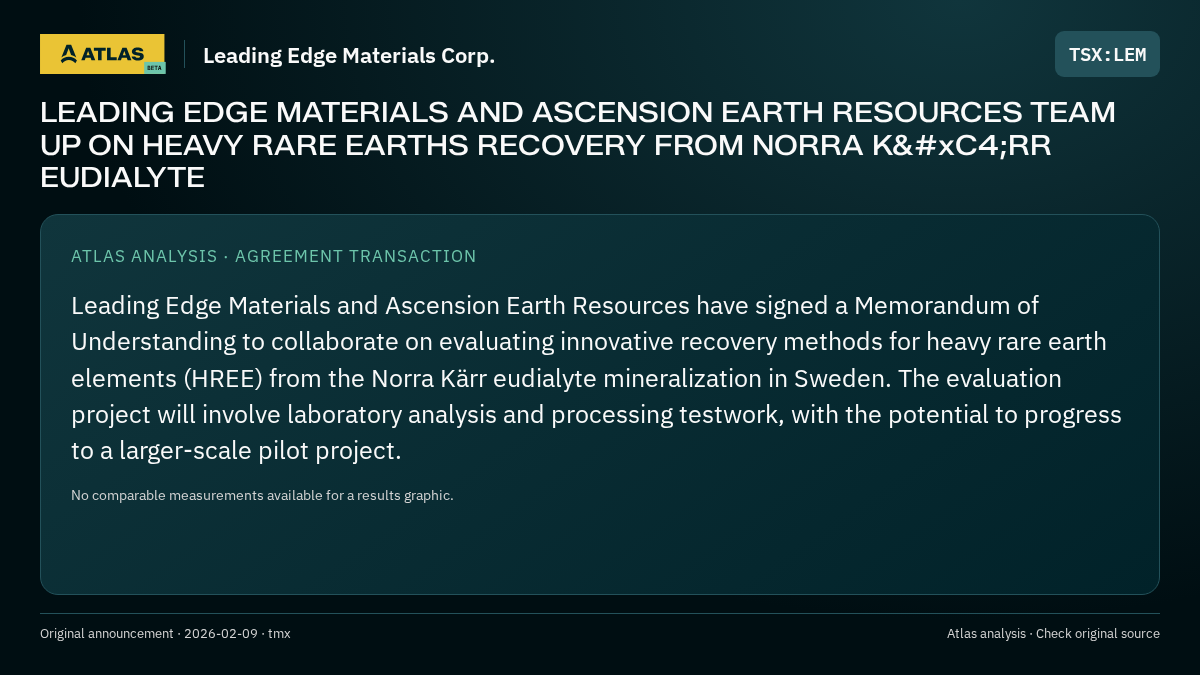
Leading Edge Materials and Ascension Earth Resources have signed a Memorandum of Understanding to collaborate on evaluating innovative recovery methods for heavy rare earth elements (HREE) from the Norra Kärr eudialyte mineralization in Sweden. The evaluation project will involve laboratory analysis and processing testwork, with the potential to progress to a larger-scale pilot project.
Reasoning: The MoU establishes a pathway to test proprietary recovery technology on the Norra Kärr deposit, which could significantly improve HREE economics.
Positive factors
- Strategic partnership with technology provider
- Focus on high-value HREE recovery
- Potential for larger-scale pilot project
Negative factors
- Contingent on successful evaluation outcomes
Facts used in scoring: 1
Classification and evidence
Bench Scale Onlynegative
Only preliminary bench tests completed — no locked-cycle or pilot work.
Why it applies: The current phase is described as an evaluation project involving laboratory analysis and processing testwork.
Evidence · text
“conduct comprehensive laboratory analysis and processing testwork”
Extracted facts
Stored fact records: 0. Some facts used in scoring do not have a stored record.
No stored fact records are available for this extraction.
How Atlas produces this analysis
Minestarters Atlas uses automated extraction to summarize mining announcements, identify reported measurements, and classify supporting evidence. Sentiment reflects the extracted narrative and classification rules; it is an interpretation, not a reported measurement. Evidence quotes and context are provided where available. Missing data, low-confidence results, and review flags indicate limitations. Check the original publisher announcement before relying on an interpretation.