
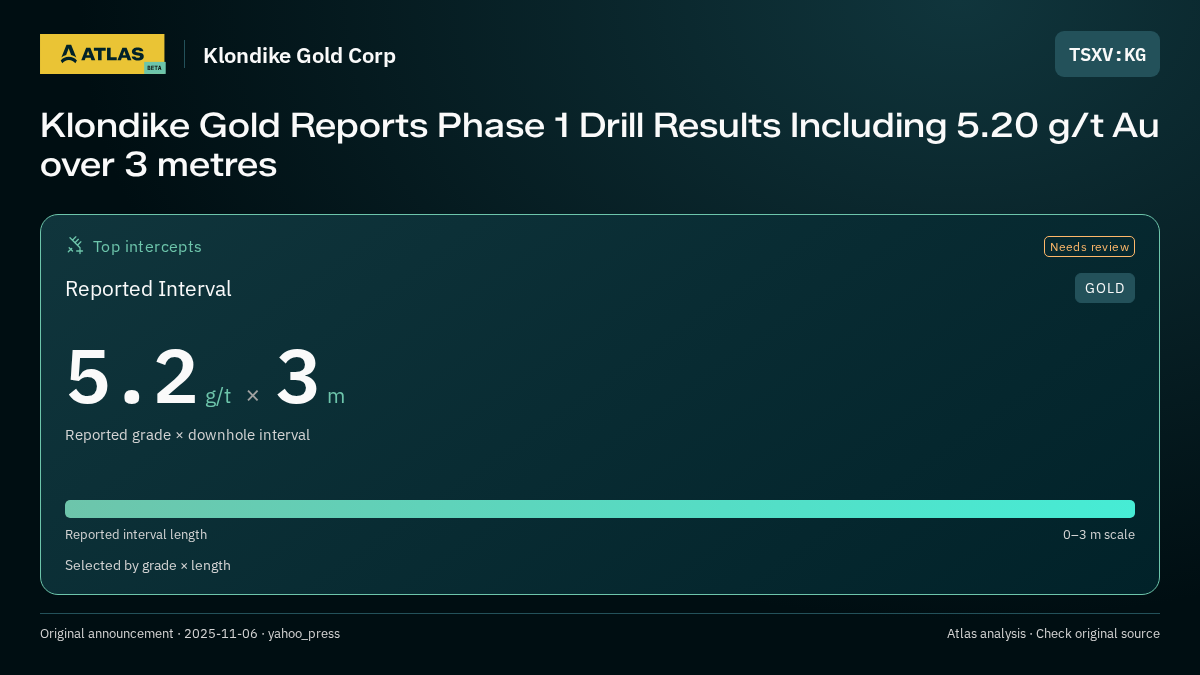
Klondike Gold Reports Phase 1 Drill Results Including 5.20 g/t Au over 3 metres
Original announcement by yahoo_press on
- Company
- Klondike Gold Corp
- Ticker
- KG
- Exchange
- TSXV
- Region
- Unavailable
- Primary commodity
- Gold
- Secondary commodities
- None reported
- Document categories
- Drill results
- Extracted
- 2026-08-21 04:34:46 UTC
Analysis by Minestarters Atlas
Minestarters Atlas analysis
Summary
Klondike Gold Corp has announced assay results from its 2025 Phase 1 diamond drill program, which covered 2,354.70 metres across 13 holes. The results include a notable intercept of 5.20 g/t gold over 3 metres.
Reasoning: The headline reports a high-grade gold intercept of 5.20 g/t over 3 metres, which meets the 'exceptional' threshold for gold in many deposit types.
Positive factors
- high-grade intercept
Facts used in scoring: 1
Classification and evidence
Bonanza Interceptpositive
Exceptionally high-grade zone, well above the deposit-type norm.
Why it applies: 5.20 g/t Au is an exceptionally high-grade zone for gold.
Evidence · text
“5.20 g/t Au over 3 metres”
Extracted facts
Stored fact records: 1. Some facts used in scoring do not have a stored record.
Drill Results (1)
Fact 1goldGrade: 5.2Grade Unit: g/tIntercept: 3 mNeeds review: drill_no_hole_idView all detailsHide details
Identity
- Commodity
- gold
- Ticker
- KG
Geometry
- Grade
- 5.2
- Grade Unit
- g/t
- Intercept
- 3 m
Classification
- Sample Type
- drill
Review
- Needs Review
- Yes
- Review Reason
- drill_no_hole_id
- Interp. Status
- scored
- Historical
- No
Dates
- Event date
- 2025-11-06T00:00:00.000Z
Reasoning: 5.20 g/t Au meets the exceptional threshold for gold.
Positive factors
- exceptional grade
Evidence · text
“5.20 g/t Au over 3 metres”
How Atlas produces this analysis
Minestarters Atlas uses automated extraction to summarize mining announcements, identify reported measurements, and classify supporting evidence. Sentiment reflects the extracted narrative and classification rules; it is an interpretation, not a reported measurement. Evidence quotes and context are provided where available. Missing data, low-confidence results, and review flags indicate limitations. Check the original publisher announcement before relying on an interpretation.