
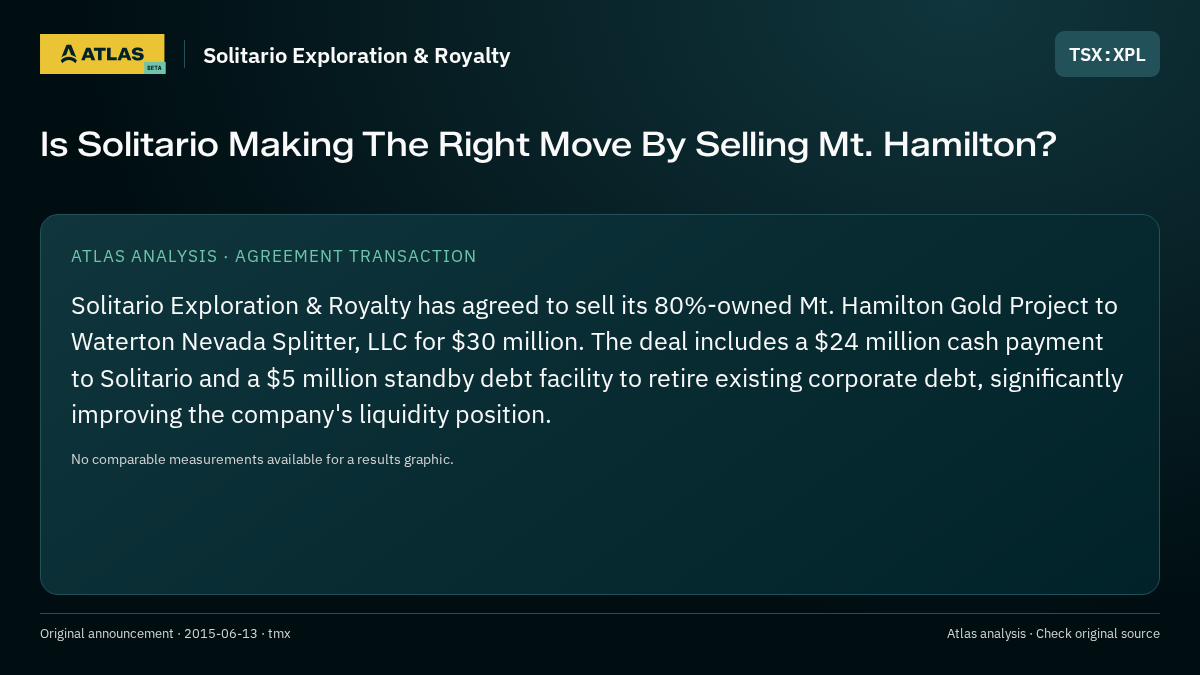
Is Solitario Making The Right Move By Selling Mt. Hamilton?
Original announcement by tmx on
- Company
- Solitario Exploration & Royalty
- Ticker
- XPL
- Exchange
- TSX
- Region
- Unavailable
- Primary commodity
- Gold
- Secondary commodities
- Zinc, Lead, Copper
- Document categories
- Agreement transaction, Resource update
- Extracted
- 2026-08-24 11:15:11 UTC
Analysis by Minestarters Atlas
Minestarters Atlas analysis
Summary
Solitario Exploration & Royalty has agreed to sell its 80%-owned Mt. Hamilton Gold Project to Waterton Nevada Splitter, LLC for $30 million. The deal includes a $24 million cash payment to Solitario and a $5 million standby debt facility to retire existing corporate debt, significantly improving the company's liquidity position.
Reasoning: The sale of a major asset provides critical liquidity to a cash-strapped company, though it removes a near-term production driver.
Positive factors
- Significant liquidity injection of $24 million
- Elimination of $5 million debt via standby facility
- De-risking of Bongara project via partner funding
Negative factors
- Loss of a key producing asset (Mt. Hamilton)
- Sale occurs despite completed permitting and feasibility study
Facts used in scoring: 3
Classification and evidence
agreement_transactionneutral · Story-specific tag
No canonical definition is currently available.
Why it applies: The document describes the sale of the Mt. Hamilton Gold Project.
Evidence · text
“entered into an agreement... to sell the Mt. Hamilton Gold Project”
resource_updateneutral · Story-specific tag
No canonical definition is currently available.
Why it applies: The document references a 2014 resource estimate for the Bongara project.
Evidence · text
“according to the 2014 resource estimate”
Extracted facts
Stored fact records: 0. Some facts used in scoring do not have a stored record.
No stored fact records are available for this extraction.
How Atlas produces this analysis
Minestarters Atlas uses automated extraction to summarize mining announcements, identify reported measurements, and classify supporting evidence. Sentiment reflects the extracted narrative and classification rules; it is an interpretation, not a reported measurement. Evidence quotes and context are provided where available. Missing data, low-confidence results, and review flags indicate limitations. Check the original publisher announcement before relying on an interpretation.