
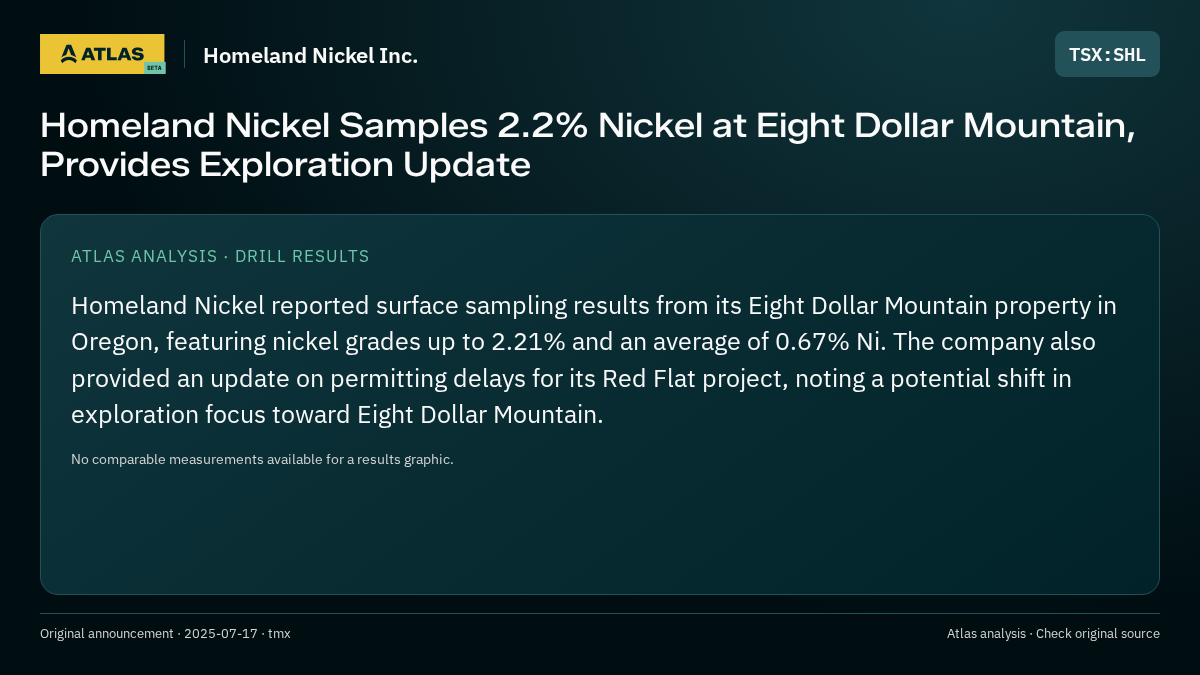
Homeland Nickel Samples 2.2% Nickel at Eight Dollar Mountain, Provides Exploration Update
Original announcement by tmx on
- Company
- Homeland Nickel Inc.
- Ticker
- SHL
- Exchange
- TSX
- Region
- Oregon
- Primary commodity
- Nickel
- Secondary commodities
- None reported
- Document categories
- Drill results, Permitting
- Extracted
- 2026-08-22 11:14:14 UTC
Analysis by Minestarters Atlas
Minestarters Atlas analysis
Summary
Homeland Nickel reported surface sampling results from its Eight Dollar Mountain property in Oregon, featuring nickel grades up to 2.21% and an average of 0.67% Ni. The company also provided an update on permitting delays for its Red Flat project, noting a potential shift in exploration focus toward Eight Dollar Mountain.
Reasoning: First sampling program at Eight Dollar Mountain yielded higher than expected average nickel grades, though permitting delays at another project create some friction.
Positive factors
- High-grade nickel intercept of 2.21% Ni
- Average grade of 0.67% Ni exceeds expectations
- QA/QC disclosed with certified lab
Negative factors
- Permitting delays at Red Flat project
Facts used in scoring: 2
Classification and evidence
QA/QC Disclosedpositive
Release includes QA/QC disclosure — certified lab, QP sign-off, or stated methods (blanks, standards, duplicates).
Why it applies: Release mentions ALS Geochemistry (ISO 17025 accredited) and use of blanks, standards, and duplicates.
Evidence · text
“All samples were collected either with a hand shovel or auger... shipped... to ALS Geochemistry in Reno, Nevada an ISO/IEC 17025 accredited lab.”
Step-Out Extensionpositive
Mineralization extended beyond the previously known limit.
Why it applies: The 2.2% Ni intercept was found at the bottom of a shallow historical pit, representing a deeper/different zone than typical surface soil.
Evidence · text
“The 2.2% Ni by contrast was taken at the bottom of a shallow historical pit”
Extracted facts
Stored fact records: 2. Some facts used in scoring do not have a stored record.
Drill Results (2)
Fact 1Eight Dollar Mountain · nickelGrade: 2.21Grade Unit: %View all detailsHide details
Identity
- Project
- Eight Dollar Mountain
- Commodity
- nickel
- Region
- oregon
- Reported Region
- Oregon
- Ticker
- SHL
Geometry
- Grade
- 2.21
- Grade Unit
- %
Classification
- Sample Type
- surface
- Mining Method
- unknown
Location
- Loc. Confidence
- medium
QA/QC
- Laboratory
- ALS Geochemistry
- QA/QC Disclosed
- Yes
- Lab Certified
- Yes
- QP Signed
- Yes
- QA/QC Methods
- blanks, standards, duplicates
Review
- Needs Review
- No
- Interp. Status
- scored
- Historical
- No
Dates
- Event date
- 2025-07-17T00:00:00.000Z
Reasoning: 2.21% Ni is significantly above the expected 0.4-0.5% Ni average for surface laterite.
Positive factors
- High grade for surface laterite
Evidence · text
“assay values ranging from 0.21% Ni to 2.21% Ni”
Fact 2Eight Dollar Mountain · nickelGrade: 0.67Grade Unit: %View all detailsHide details
Identity
- Project
- Eight Dollar Mountain
- Commodity
- nickel
- Region
- oregon
- Reported Region
- Oregon
- Ticker
- SHL
Geometry
- Grade
- 0.67
- Grade Unit
- %
Classification
- Sample Type
- surface
- Mining Method
- unknown
Location
- Loc. Confidence
- medium
QA/QC
- Laboratory
- ALS Geochemistry
- QA/QC Disclosed
- Yes
- Lab Certified
- Yes
- QP Signed
- Yes
- QA/QC Methods
- blanks, standards, duplicates
Review
- Needs Review
- No
- Interp. Status
- scored
- Historical
- No
Dates
- Event date
- 2025-07-17T00:00:00.000Z
Reasoning: The average grade of 0.67% Ni is higher than the expected 0.4-0.5% Ni range.
Positive factors
- Exceeds expected average grade
Evidence · text
“an average of 0.67% Ni”
How Atlas produces this analysis
Minestarters Atlas uses automated extraction to summarize mining announcements, identify reported measurements, and classify supporting evidence. Sentiment reflects the extracted narrative and classification rules; it is an interpretation, not a reported measurement. Evidence quotes and context are provided where available. Missing data, low-confidence results, and review flags indicate limitations. Check the original publisher announcement before relying on an interpretation.