
Guanajuato Silver Reports Second Consecutive Quarter of Positive Net Income
Original announcement by orestocks on
- Company
- Guanajuato Silver Company Ltd.
- Ticker
- GSVR
- Exchange
- Unavailable
- Region
- Guanajuato, Mexico
- Primary commodity
- Silver
- Secondary commodities
- Gold, Lead, Zinc
- Document categories
- Production, Drill results
- Extracted
- 2026-08-26 12:46:11 UTC
Analysis by Minestarters Atlas
Minestarters Atlas analysis
Summary
Guanajuato Silver reported its second consecutive quarter of positive net income for Q2 2026, with $557,000 in net profit. The company also achieved significant debt reduction by accelerating a gold loan repayment and reported increased drilling activity across its Mexican assets.
Reasoning: The company shows strong financial momentum with positive net income and debt reduction, though it is navigating operational transitions at Bolanitos and a strategic pause at VMC.
Positive factors
- Second consecutive quarter of positive net income
- Substantial debt reduction via accelerated gold loan repayment
- Increased silver production (+2% QoQ)
- Significant increase in drilling activity at El Cubo (+423% YoY)
- High-grade silver-equivalent intercepts at VMC
Negative factors
- Gold production down 15% QoQ
- Elevated operating costs at Bolanitos due to development needs
- Decision to pause extraction at VMC to focus on exploration/planning
Facts used in scoring: 11
Classification and evidence
True Width Disclosedpositive
Actual thickness perpendicular to structure is stated, not just downhole length.
Why it applies: Multiple intercepts at VMC report true width perpendicular to structure.
Evidence · text
“across a true width of 3.81 metres”
Bonanza Interceptpositive
Exceptionally high-grade zone, well above the deposit-type norm.
Why it applies: Intercept UGSM26-001 reports 856 g/t AgEq, well above deposit norms.
Evidence · text
“returned 856g/t AgEq”
QA/QC Disclosedpositive
Release includes QA/QC disclosure — certified lab, QP sign-off, or stated methods (blanks, standards, duplicates).
Why it applies: Qualified Person William Gehlen verified technical data and detected no significant QA/QC issues.
Evidence · text
“detected no significant QA/QC issues during review of the data”
Extracted facts
Stored fact records: 10. Some facts used in scoring do not have a stored record.
Drill Results (10)
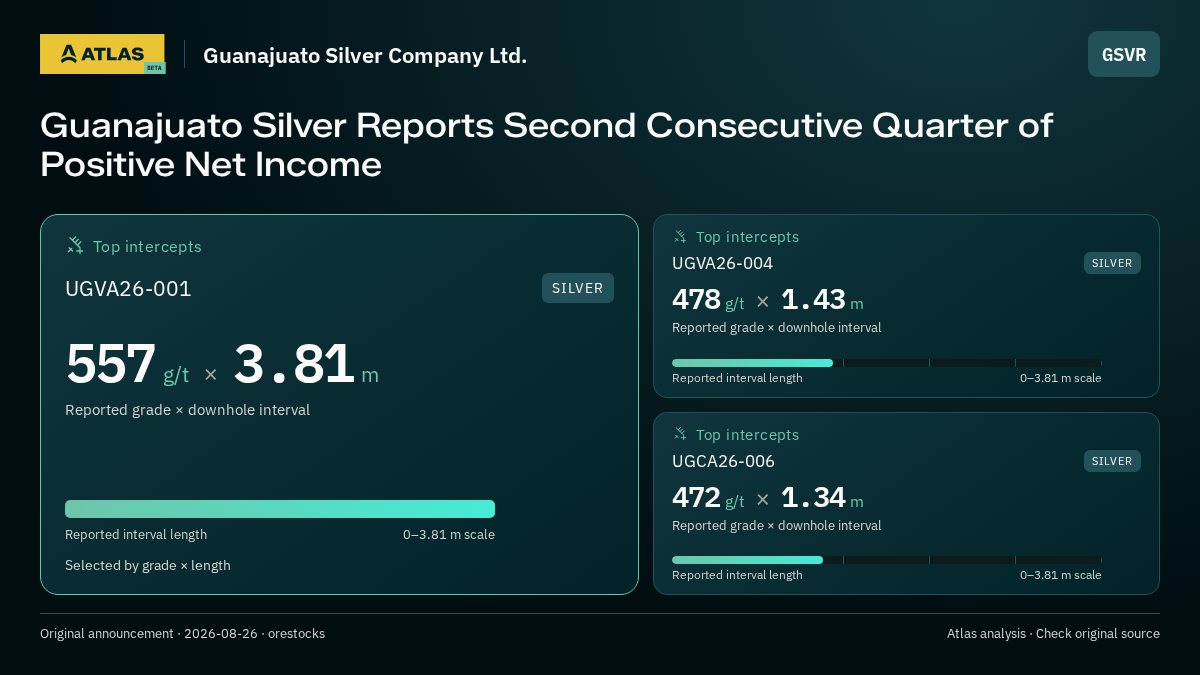
UGVA26-001silverGrade: 557Grade Unit: g/tIntercept: 3.81 mView all detailsHide details
Identity
- Hole ID
- UGVA26-001
- Commodity
- silver
- Ticker
- GSVR
Geometry
- Grade
- 557
- Grade Unit
- g/t
- Intercept
- 3.81 m
Classification
- Sample Type
- drill
Review
- Needs Review
- No
- Interp. Status
- scored
- Historical
- No
Dates
- Event date
- 2026-08-26T00:00:00.000Z
Reasoning: Expanded from assay table. 557 g/t silver is exceptional against the default band [500, 200, 100, 30] g/t. Grade×width 2122.2 g/t·m is moderate (grade alone is exceptional; the better of the two is used).
Positive factors
- 557 g/t silver is exceptional on the default band.
Negative factors
- Scored from rubric bands during table expansion, not from document context.
Evidence · table
“557”
Context: UGVA26-001
UGVA26-001goldGrade: 4Grade Unit: g/tIntercept: 3.81 mView all detailsHide details
Identity
- Hole ID
- UGVA26-001
- Commodity
- gold
- Ticker
- GSVR
Geometry
- Grade
- 4
- Grade Unit
- g/t
- Intercept
- 3.81 m
Classification
- Sample Type
- drill
Review
- Needs Review
- No
- Interp. Status
- scored
- Historical
- No
Dates
- Event date
- 2026-08-26T00:00:00.000Z
Reasoning: Expanded from assay table. 4 g/t gold is strong against the default band [5, 2, 1, 0.3] g/t. Grade×width 15.2 g/t·m is weak (grade alone is strong; the better of the two is used).
Positive factors
- 4 g/t gold is strong on the default band.
Negative factors
- Scored from rubric bands during table expansion, not from document context.
Evidence · table
“4.0”
Context: UGVA26-001
UGVA26-004silverGrade: 478Grade Unit: g/tIntercept: 1.43 mView all detailsHide details
Identity
- Hole ID
- UGVA26-004
- Commodity
- silver
- Ticker
- GSVR
Geometry
- Grade
- 478
- Grade Unit
- g/t
- Intercept
- 1.43 m
Classification
- Sample Type
- drill
Review
- Needs Review
- No
- Interp. Status
- scored
- Historical
- No
Dates
- Event date
- 2026-08-26T00:00:00.000Z
Reasoning: Expanded from assay table. 478 g/t silver is strong against the default band [500, 200, 100, 30] g/t. Grade×width 683.5 g/t·m is weak (grade alone is strong; the better of the two is used).
Positive factors
- 478 g/t silver is strong on the default band.
Negative factors
- Scored from rubric bands during table expansion, not from document context.
Evidence · table
“478”
Context: UGVA26-004
UGVA26-004goldGrade: 1.3Grade Unit: g/tIntercept: 1.43 mView all detailsHide details
Identity
- Hole ID
- UGVA26-004
- Commodity
- gold
- Ticker
- GSVR
Geometry
- Grade
- 1.3
- Grade Unit
- g/t
- Intercept
- 1.43 m
Classification
- Sample Type
- drill
Review
- Needs Review
- No
- Interp. Status
- scored
- Historical
- No
Dates
- Event date
- 2026-08-26T00:00:00.000Z
Reasoning: Expanded from assay table. 1.3 g/t gold is moderate against the default band [5, 2, 1, 0.3] g/t. Grade×width 1.9 g/t·m is below (grade alone is moderate; the better of the two is used).
Negative factors
- Scored from rubric bands during table expansion, not from document context.
Evidence · table
“1.3”
Context: UGVA26-004
UGCA26-004silverGrade: 130Grade Unit: g/tIntercept: 2.52 mView all detailsHide details
Identity
- Hole ID
- UGCA26-004
- Commodity
- silver
- Ticker
- GSVR
Geometry
- Grade
- 130
- Grade Unit
- g/t
- Intercept
- 2.52 m
Classification
- Sample Type
- drill
Review
- Needs Review
- No
- Interp. Status
- scored
- Historical
- No
Dates
- Event date
- 2026-08-26T00:00:00.000Z
Reasoning: Expanded from assay table. 130 g/t silver is moderate against the default band [500, 200, 100, 30] g/t. Grade×width 327.6 g/t·m is weak (grade alone is moderate; the better of the two is used).
Negative factors
- Scored from rubric bands during table expansion, not from document context.
Evidence · table
“130”
Context: UGCA26-004
UGCA26-004goldGrade: 0.33Grade Unit: g/tIntercept: 2.52 mView all detailsHide details
Identity
- Hole ID
- UGCA26-004
- Commodity
- gold
- Ticker
- GSVR
Geometry
- Grade
- 0.33
- Grade Unit
- g/t
- Intercept
- 2.52 m
Classification
- Sample Type
- drill
Review
- Needs Review
- No
- Interp. Status
- scored
- Historical
- No
Dates
- Event date
- 2026-08-26T00:00:00.000Z
Reasoning: Expanded from assay table. 0.33 g/t gold is weak against the default band [5, 2, 1, 0.3] g/t. Grade×width 0.8 g/t·m is below (grade alone is weak; the better of the two is used).
Negative factors
- Scored from rubric bands during table expansion, not from document context.
Evidence · table
“0.33”
Context: UGCA26-004
UGCA26-006silverGrade: 472Grade Unit: g/tIntercept: 1.34 mView all detailsHide details
Identity
- Hole ID
- UGCA26-006
- Commodity
- silver
- Ticker
- GSVR
Geometry
- Grade
- 472
- Grade Unit
- g/t
- Intercept
- 1.34 m
Classification
- Sample Type
- drill
Review
- Needs Review
- No
- Interp. Status
- scored
- Historical
- No
Dates
- Event date
- 2026-08-26T00:00:00.000Z
Reasoning: Expanded from assay table. 472 g/t silver is strong against the default band [500, 200, 100, 30] g/t. Grade×width 632.5 g/t·m is weak (grade alone is strong; the better of the two is used).
Positive factors
- 472 g/t silver is strong on the default band.
Negative factors
- Scored from rubric bands during table expansion, not from document context.
Evidence · table
“472”
Context: UGCA26-006
UGCA26-006goldGrade: 2.13Grade Unit: g/tIntercept: 1.34 mView all detailsHide details
Identity
- Hole ID
- UGCA26-006
- Commodity
- gold
- Ticker
- GSVR
Geometry
- Grade
- 2.13
- Grade Unit
- g/t
- Intercept
- 1.34 m
Classification
- Sample Type
- drill
Review
- Needs Review
- No
- Interp. Status
- scored
- Historical
- No
Dates
- Event date
- 2026-08-26T00:00:00.000Z
Reasoning: Expanded from assay table. 2.13 g/t gold is strong against the default band [5, 2, 1, 0.3] g/t. Grade×width 2.9 g/t·m is below (grade alone is strong; the better of the two is used).
Positive factors
- 2.13 g/t gold is strong on the default band.
Negative factors
- Scored from rubric bands during table expansion, not from document context.
Evidence · table
“2.13”
Context: UGCA26-006
UGSM26-001silverGrade: 520Grade Unit: g/tIntercept: 0.92 mView all detailsHide details
Identity
- Hole ID
- UGSM26-001
- Commodity
- silver
- Ticker
- GSVR
Geometry
- Grade
- 520
- Grade Unit
- g/t
- Intercept
- 0.92 m
Classification
- Sample Type
- drill
Review
- Needs Review
- No
- Interp. Status
- scored
- Historical
- No
Dates
- Event date
- 2026-08-26T00:00:00.000Z
Reasoning: Expanded from assay table. 520 g/t silver is exceptional against the default band [500, 200, 100, 30] g/t. Grade×width 478.4 g/t·m is weak (grade alone is exceptional; the better of the two is used).
Positive factors
- 520 g/t silver is exceptional on the default band.
Negative factors
- Scored from rubric bands during table expansion, not from document context.
Evidence · table
“520”
Context: UGSM26-001
UGSM26-001goldGrade: 4.6Grade Unit: g/tIntercept: 0.92 mView all detailsHide details
Identity
- Hole ID
- UGSM26-001
- Commodity
- gold
- Ticker
- GSVR
Geometry
- Grade
- 4.6
- Grade Unit
- g/t
- Intercept
- 0.92 m
Classification
- Sample Type
- drill
Review
- Needs Review
- No
- Interp. Status
- scored
- Historical
- No
Dates
- Event date
- 2026-08-26T00:00:00.000Z
Reasoning: Expanded from assay table. 4.6 g/t gold is strong against the default band [5, 2, 1, 0.3] g/t. Grade×width 4.2 g/t·m is below (grade alone is strong; the better of the two is used).
Positive factors
- 4.6 g/t gold is strong on the default band.
Negative factors
- Scored from rubric bands during table expansion, not from document context.
Evidence · table
“4.60”
Context: UGSM26-001
How Atlas produces this analysis
Minestarters Atlas uses automated extraction to summarize mining announcements, identify reported measurements, and classify supporting evidence. Sentiment reflects the extracted narrative and classification rules; it is an interpretation, not a reported measurement. Evidence quotes and context are provided where available. Missing data, low-confidence results, and review flags indicate limitations. Check the original publisher announcement before relying on an interpretation.