
Greenland-focused rare earths developer Eclipse proceeds with more advanced testwork
Original announcement by miningweekly on
- Company
- Eclipse Metals
- Ticker
- ASX: ECL
- Exchange
- Unavailable
- Region
- Greenland
- Primary commodity
- Rare earths
- Secondary commodities
- Neodymium, Praseodymium
- Document categories
- Metallurgy
- Extracted
- 2026-09-03 08:34:14 UTC
Analysis by Minestarters Atlas
Minestarters Atlas analysis
Summary
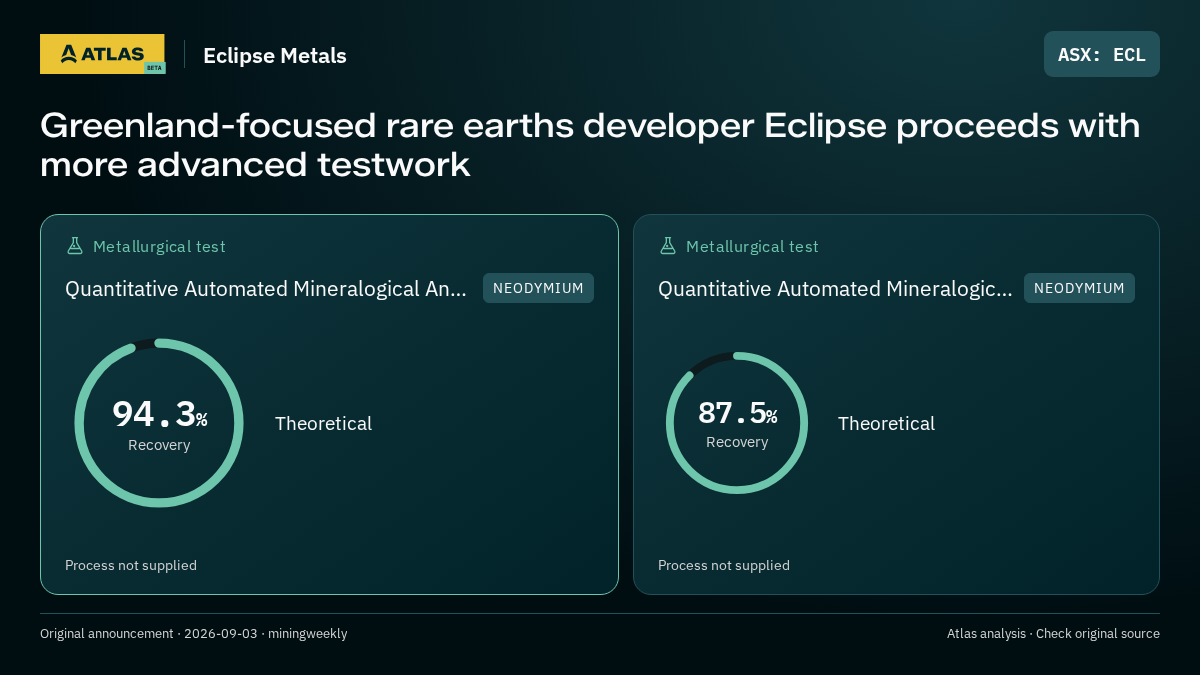
Eclipse Metals reported encouraging mineralogical results from ALS Metallurgy on four composite samples from the Ivigtût project in Greenland. The analysis shows that NdPr is predominantly hosted in specific mineral groups (87.5% to 94.3%), establishing a basis for future flotation and reagent-optimisation testing.
Reasoning: Quantitative mineralogical analysis shows high NdPr hosting in specific mineral groups (87.5-94.3%), providing a sound basis for upcoming flotation testwork.
Positive factors
- high mineralogical deportment
- clear beneficiation pathway identified
Negative factors
- not actual flotation recoveries
Facts used in scoring: 2
Classification and evidence
Bench Scale Onlynegative
Only preliminary bench tests completed — no locked-cycle or pilot work.
Why it applies: The results are from quantitative automated mineralogical analysis on composites, not actual flotation or pilot testing.
Evidence · text
“The reported percentages describe mineralogical deportment and surface exposure; they are not flotation recoveries or concentrate grades.”
Mill Routeneutral
Processing via mill or concentrator (CIL, CIP, tank leach, flotation).
Why it applies: The company intends to convert mineralogical findings into flotation recovery and concentrate grade.
Evidence · text
“Our focus will be to convert this mineralogical opportunity into measured flotation recovery and concentrate grade”
Extracted facts
Stored fact records: 2. Some facts used in scoring do not have a stored record.
Metallurgical Results (2)
quantitative automated mineralogical analysisneodymiumRecovery: 94.3 %View all detailsHide details
Identity
- Commodity
- neodymium
- Ticker
- ASX: ECL
Test Work
- Program Status
- preliminary
- Test Type
- quantitative automated mineralogical analysis
- Sample
- four composite samples from the Ivigtût project
Recovery
- Recovery
- 94.3 %
- Recovery Basis
- theoretical
Lab
- Laboratory
- ALS Metallurgy
Review
- Needs Review
- No
- Historical
- No
Dates
- Event date
- 2026-09-03T00:00:00.000Z
Reasoning: Upper bound of NdPr hosting in identified mineral groups is 94.3%.
Positive factors
- high mineralogical deportment
Negative factors
- theoretical basis only
Evidence · text
“With between 87.5% and 94.3% of NdPr hosted in identified rare earth-bearing mineral groups across four composites”
quantitative automated mineralogical analysisneodymiumRecovery: 87.5 %View all detailsHide details
Identity
- Commodity
- neodymium
- Ticker
- ASX: ECL
Test Work
- Program Status
- preliminary
- Test Type
- quantitative automated mineralogical analysis
- Sample
- four composite samples from the Ivigtût project
Recovery
- Recovery
- 87.5 %
- Recovery Basis
- theoretical
Lab
- Laboratory
- ALS Metallurgy
Review
- Needs Review
- No
- Historical
- No
Dates
- Event date
- 2026-09-03T00:00:00.000Z
Reasoning: Lower bound of NdPr hosting in identified mineral groups is 87.5%.
Positive factors
- high mineralogical deportment
Negative factors
- theoretical basis only
Evidence · text
“With between 87.5% and 94.3% of NdPr hosted in identified rare earth-bearing mineral groups across four composites”
How Atlas produces this analysis
Minestarters Atlas uses automated extraction to summarize mining announcements, identify reported measurements, and classify supporting evidence. Sentiment reflects the extracted narrative and classification rules; it is an interpretation, not a reported measurement. Evidence quotes and context are provided where available. Missing data, low-confidence results, and review flags indicate limitations. Check the original publisher announcement before relying on an interpretation.