
Gold Project in Southern Kazakhstan
Original announcement by minemarket on
- Company
- Unavailable
- Ticker
- Unavailable
- Exchange
- Unavailable
- Region
- Kazakhstan
- Primary commodity
- Gold
- Secondary commodities
- None reported
- Document categories
- Resource update, Metallurgy, Agreement transaction
- Extracted
- 2026-08-20 19:48:22 UTC
Analysis by Minestarters Atlas
Minestarters Atlas analysis
Summary
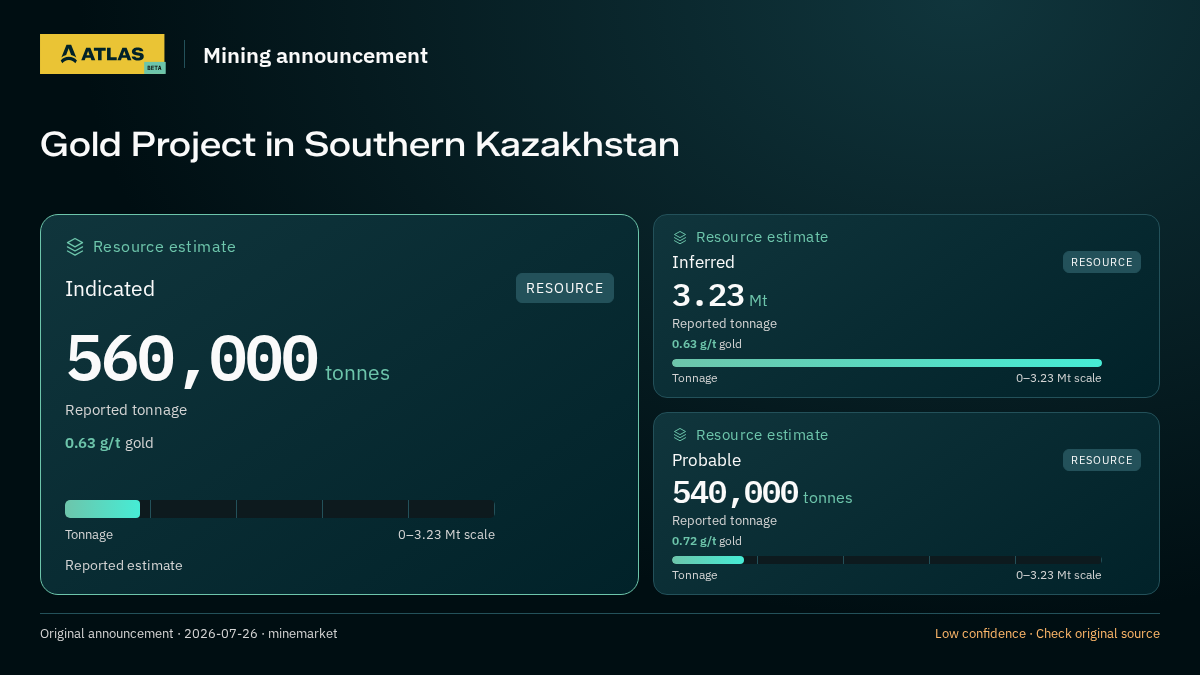
A gold project in Kazakhstan is being offered via an equity stake in its parent company, accompanied by a USD 27 million development programme. The project holds a KAZRC-compliant resource of 3.8 Mt at 0.63 g/t gold, with ongoing drilling and trenching to upgrade resource confidence.
Reasoning: The announcement details a significant gold resource and a development plan for a Kazakhstan project, though the resource is heavily weighted toward the Inferred category.
Positive factors
- Strong IRR and NPV in vendor model
- Free-milling ore with good recovery
- Conversion of exploration contract to licence
- Established infrastructure
Negative factors
- Low average resource grade (0.63 g/t)
- High proportion of Inferred resources (85%)
Low confidence — this extraction should be reviewed alongside the original source.
Facts used in scoring: 4
Classification and evidence
Inferred Resourcenegative
Speculative category — limited drilling, geological continuity assumed but not confirmed. Cannot support economic studies alone.
Why it applies: The majority of the resource (3.23 Mt out of 3.8 Mt) is in the Inferred category.
Evidence · text
“Inferred resources of 3.23 t”
Probable Reservepositive
Indicated Resource with demonstrated economic viability after applying modifying factors.
Why it applies: The project has approved Probable reserves.
Evidence · text
“support approved Probable reserves of 0.54 t”
Free Millingpositive
Simple, clean ore amenable to standard processing without oxidation.
Why it applies: The ore is explicitly described as free-milling.
Evidence · text
“Free-milling ore”
Extracted facts
Stored fact records: 4. Some facts used in scoring do not have a stored record.
Resource Estimates (4)
indicatedgoldTonnes: 560000Grade: 0.63Grade Unit: g/tView all detailsHide details
Identity
- Commodity
- gold
Resource Data
- Category
- indicated
- Tonnes
- 560000
- Grade
- 0.63
- Grade Unit
- g/t
Review
- Needs Review
- No
- Historical
- No
Dates
- Event date
- 2026-07-26T00:00:00.000Z
Reasoning: Indicated portion of the resource.
Evidence · text
“Indicated resources of 0.56 t”
inferredgoldTonnes: 3230000Grade: 0.63Grade Unit: g/tView all detailsHide details
Identity
- Commodity
- gold
Resource Data
- Category
- inferred
- Tonnes
- 3230000
- Grade
- 0.63
- Grade Unit
- g/t
Review
- Needs Review
- No
- Historical
- No
Dates
- Event date
- 2026-07-26T00:00:00.000Z
Reasoning: Large Inferred component limits immediate economic confidence.
Negative factors
- High proportion of Inferred material
Evidence · text
“Inferred resources of 3.23 t”
probablegoldTonnes: 540000Grade: 0.72Grade Unit: g/tView all detailsHide details
Identity
- Commodity
- gold
Resource Data
- Category
- probable
- Tonnes
- 540000
- Grade
- 0.72
- Grade Unit
- g/t
Review
- Needs Review
- No
- Historical
- No
Dates
- Event date
- 2026-07-26T00:00:00.000Z
Reasoning: Economic subset of the resource.
Positive factors
- Probable reserves established
Evidence · text
“Probable reserves of 0.54 t at 0.72 g/t”
Fact 4goldView all detailsHide details
Identity
- Commodity
- gold
Review
- Needs Review
- No
- Historical
- No
Dates
- Event date
- 2026-07-26T00:00:00.000Z
Reasoning: Reported recovery is solid for the stated flowsheet.
Positive factors
- Free-milling ore
- Good recovery for gravity/cyanidation
Negative factors
- No roasting or autoclave required (implies simple but standard)
Evidence · text
“Free-milling ore with 87% gold recovery on a gravity and cyanidation flowsheet”
How Atlas produces this analysis
Minestarters Atlas uses automated extraction to summarize mining announcements, identify reported measurements, and classify supporting evidence. Sentiment reflects the extracted narrative and classification rules; it is an interpretation, not a reported measurement. Evidence quotes and context are provided where available. Missing data, low-confidence results, and review flags indicate limitations. Check the original publisher announcement before relying on an interpretation.