
Galway Metals Completes 5,000-Metre Drill Program at Estrades Amid Strong Metal Prices
Original announcement by orestocks on
- Company
- Galway Metals Inc.
- Ticker
- GWM.V
- Exchange
- Unavailable
- Region
- Québec
- Primary commodity
- Gold
- Secondary commodities
- Zinc, Copper, Silver, Lead
- Document categories
- Metallurgy, Other
- Extracted
- 2026-09-15 11:31:30 UTC
Analysis by Minestarters Atlas
Minestarters Atlas analysis
Summary
Galway Metals has completed a 5,000-metre, 13-hole diamond drill program at the Estrades Project in Québec. While assay results are pending, the program was designed to provide material for upcoming metallurgical testwork and geological evaluation under their joint venture with Dowa Metals.
Reasoning: The company completed a significant drill program and metallurgical sampling, but actual assay results are not yet released, making the geological impact currently unquantifiable.
Positive factors
- completion of 5,000m drill program
- strong metal prices
- improved gold recovery mentioned
- strategic JV with Dowa
Negative factors
- assay results pending
Facts used in scoring: 3
Classification and evidence
Metallurgical Improvementspositive · Story-specific tag
No canonical definition is currently available.
Why it applies: The company highlights a 31% improvement in gold recovery to 86.6%.
Evidence · text
“31% improvement in gold recovery to 86.6%”
Mill Routeneutral
Processing via mill or concentrator (CIL, CIP, tank leach, flotation).
Why it applies: the document describes a flotation route ("concentrate")
Multi-Domain Testedpositive
Variability across ore domains (oxide, transition, fresh) has been addressed.
Why it applies: 2 distinct composites were tested
Extracted facts
Stored fact records: 3. Some facts used in scoring do not have a stored record.
Metallurgical Results (3)
Fact 1goldRecovery: 86.6 %Historical resultNeeds review: historical_restatementView all detailsHide details
Identity
- Commodity
- gold
- Region
- canada_qc
- Reported Region
- Québec
- Ticker
- GWM.V
Test Work
- Sample
- previously disclosed metallurgical testwork
Recovery
- Recovery
- 86.6 %
- Recovery Basis
- actual_test
Review
- Needs Review
- Yes
- Review Reason
- historical_restatement
- Historical
- Yes
- Historical Source Date
- 2025-01-27T00:00:00.000Z
Dates
- Event date
- 2026-09-15T00:00:00.000Z
Reasoning: Historical recovery improvement of 31% to 86.6% is a strong baseline for the project.
Positive factors
- 31% improvement in recovery
Evidence · text
“31% improvement in gold recovery to 86.6% (News Release dated January 27, 2025)”
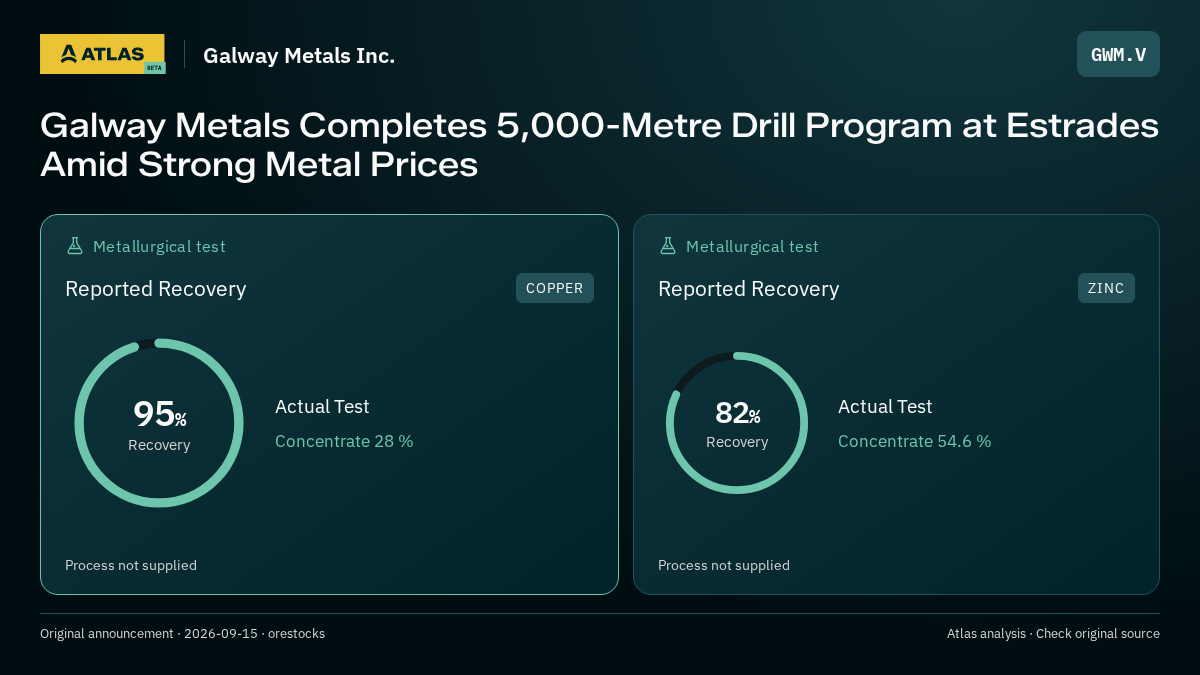
Fact 2copperRecovery: 95 %View all detailsHide details
Identity
- Commodity
- copper
- Region
- canada_qc
- Reported Region
- Québec
- Ticker
- GWM.V
Test Work
- Sample
- open-circuit testing
Recovery
- Recovery
- 95 %
- Recovery Basis
- actual_test
- Conc. Grade
- 28
- Conc. Grade Unit
- %
Review
- Needs Review
- No
- Historical
- No
Dates
- Event date
- 2026-09-15T00:00:00.000Z
Reasoning: Strong copper concentrate results from previous open-circuit testing.
Positive factors
- high concentrate grade
- high recovery
Evidence · text
“copper concentrate grading 28% Cu at 95% copper recovery”
Tags used in scoring
High Recoverypositive
Recovery at or above the exceptional band for the commodity and processing route.
Why it applies: 95% is at or above the exceptional band (92%)
Fact 3zincRecovery: 82 %View all detailsHide details
Identity
- Commodity
- zinc
- Region
- canada_qc
- Reported Region
- Québec
- Ticker
- GWM.V
Test Work
- Sample
- open-circuit testing
Recovery
- Recovery
- 82 %
- Recovery Basis
- actual_test
- Conc. Grade
- 54.6
- Conc. Grade Unit
- %
Review
- Needs Review
- No
- Historical
- No
Dates
- Event date
- 2026-09-15T00:00:00.000Z
Reasoning: Strong zinc concentrate results from previous open-circuit testing.
Positive factors
- high concentrate grade
Evidence · text
“zinc concentrate grading 54.6% Zn at 82% zinc recovery”
How Atlas produces this analysis
Minestarters Atlas uses automated extraction to summarize mining announcements, identify reported measurements, and classify supporting evidence. Sentiment reflects the extracted narrative and classification rules; it is an interpretation, not a reported measurement. Evidence quotes and context are provided where available. Missing data, low-confidence results, and review flags indicate limitations. Check the original publisher announcement before relying on an interpretation.