
Decade Resources drills into porphyry-style copper at Bonaparte Project, British Columbia
Original announcement by resourceworld on
- Company
- Decade Resources Ltd.
- Ticker
- DEC
- Exchange
- Unavailable
- Region
- British Columbia
- Primary commodity
- Copper
- Secondary commodities
- Gold, Molybdenum
- Document categories
- Drill results
- Extracted
- 2026-09-01 16:20:43 UTC
Analysis by Minestarters Atlas
Minestarters Atlas analysis
Summary
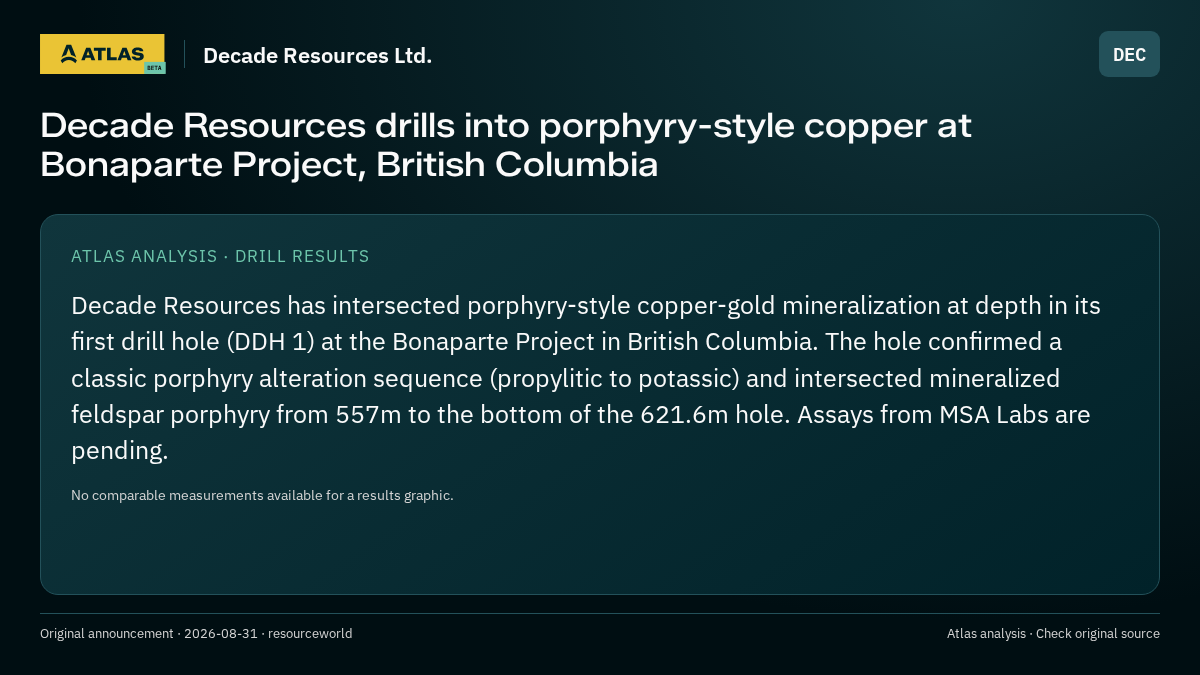
Decade Resources has intersected porphyry-style copper-gold mineralization at depth in its first drill hole (DDH 1) at the Bonaparte Project in British Columbia. The hole confirmed a classic porphyry alteration sequence (propylitic to potassic) and intersected mineralized feldspar porphyry from 557m to the bottom of the 621.6m hole. Assays from MSA Labs are pending.
Reasoning: The first drill hole of the program successfully intersected porphyry-style alteration and mineralization, confirming the geological model, though specific grades are not yet available.
Positive factors
- geological confirmation of porphyry model
- classic alteration zonation observed
- intersection of mineralization at depth
Negative factors
- assays pending
- visual observations only
Facts used in scoring: 2
Classification and evidence
QA/QC Disclosedpositive
Release includes QA/QC disclosure — certified lab, QP sign-off, or stated methods (blanks, standards, duplicates).
Why it applies: The release mentions that assays will be reviewed by a qualified person and submitted to MSA Labs.
Evidence · text
“results will be released once received, compiled and reviewed by the company’s qualified person.”
Extracted facts
Stored fact records: 2. Some facts used in scoring do not have a stored record.
Drill Results (2)
DDH 1Bonaparte · copperIntercept: 64.6 mNeeds review: ungroundedView all detailsHide details
Identity
- Hole ID
- DDH 1
- Project
- Bonaparte
- Commodity
- copper
- Region
- canada_bc
- Reported Region
- British Columbia
- Ticker
- DEC
Geometry
- Intercept
- 64.6 m
- From
- 557 m
- To
- 621.6 m
- Hole Depth
- 621.6 m
Classification
- Deposit Type
- porphyry
- Program
- exploration
- Sample Type
- drill
- Group ID
- DDH 1:557-621.6
- Mining Method
- open_pit
QA/QC
- Laboratory
- MSA LABS
- QA/QC Disclosed
- Yes
Review
- Needs Review
- Yes
- Review Reason
- ungrounded
- Interp. Status
- scored
- Historical
- No
Dates
- Event date
- 2026-08-31T00:00:00.000Z
Reasoning: Visual intersection of chalcopyrite in a porphyry alteration sequence confirms the target model, but grade is unconfirmed.
Positive factors
- first drill test of concept
- classic porphyry zonation
Negative factors
- assays pending
- visual observations only
Evidence · text
“intersected porphyry-style mineralization consisting of chalcopyrite with occasional molybdenite at depth”
DDH 1Bonaparte · molybdenumIntercept: 64.6 mNeeds review: ungroundedView all detailsHide details
Identity
- Hole ID
- DDH 1
- Project
- Bonaparte
- Commodity
- molybdenum
- Region
- canada_bc
- Reported Region
- British Columbia
- Ticker
- DEC
Geometry
- Intercept
- 64.6 m
- From
- 557 m
- To
- 621.6 m
- Hole Depth
- 621.6 m
Classification
- Deposit Type
- porphyry
- Program
- exploration
- Sample Type
- drill
- Group ID
- DDH 1:557-621.6
- Mining Method
- open_pit
QA/QC
- Laboratory
- MSA LABS
- QA/QC Disclosed
- Yes
Review
- Needs Review
- Yes
- Review Reason
- ungrounded
- Interp. Status
- scored
- Historical
- No
Dates
- Event date
- 2026-08-31T00:00:00.000Z
Reasoning: Occasional molybdenite noted visually in the copper interval; grade pending.
Positive factors
- presence of molybdenite in porphyry system
Negative factors
- assays pending
Evidence · text
“consisting of chalcopyrite with occasional molybdenite at depth”
How Atlas produces this analysis
Minestarters Atlas uses automated extraction to summarize mining announcements, identify reported measurements, and classify supporting evidence. Sentiment reflects the extracted narrative and classification rules; it is an interpretation, not a reported measurement. Evidence quotes and context are provided where available. Missing data, low-confidence results, and review flags indicate limitations. Check the original publisher announcement before relying on an interpretation.