
Cordoba Minerals Identifies the Leached Cap of a Porphyry Copper System at the Perseverance Project in Arizona, USA
Original announcement by tmx on
- Company
- Cordoba Minerals Corp.
- Ticker
- CDB
- Exchange
- TSX
- Region
- Arizona, USA
- Primary commodity
- Copper
- Secondary commodities
- Gold, Silver, Zinc, Lead
- Document categories
- Drill results, Other
- Extracted
- 2026-08-21 10:03:59 UTC
Analysis by Minestarters Atlas
Minestarters Atlas analysis
Summary
Cordoba Minerals has identified a potential leached cap of a porphyry copper system at the Perseverance project in Arizona via hole K-23. The hole intersected Laramide-age porphyry units at 516m, and assays for the 516-590m interval are pending.
Reasoning: The drill hole K-23 identified a leached cap and Laramide porphyry units, which are strong geological indicators of a porphyry copper system, though specific grades for the new interval are not yet released.
Positive factors
- Identification of leached cap indicative of porphyry system
- Intersection of Laramide-age porphyry units
- Proximity to known giant porphyry systems
Negative factors
- Assays for the primary K-23 interval are still pending
Facts used in scoring: 2
Classification and evidence
QA/QC Disclosedpositive
Release includes QA/QC disclosure — certified lab, QP sign-off, or stated methods (blanks, standards, duplicates).
Why it applies: The release mentions the technical information was reviewed and verified by a Qualified Person (Charles N. Forster, P.Geo.)
Evidence · text
“The technical information in this release has been reviewed and verified by Charles N. Forster, P.Geo., a Qualified Person”
Nearology Playneutral
Value premise rests on proximity to a known deposit rather than own results.
Why it applies: The company references the proximity to the giant Resolution porphyry copper deposit owned by Rio Tinto.
Evidence · text
“shares the characteristic features of the giant, high-grade Resolution porphyry copper deposit in Arizona”
Extracted facts
Stored fact records: 2. Some facts used in scoring do not have a stored record.
Drill Results (2)
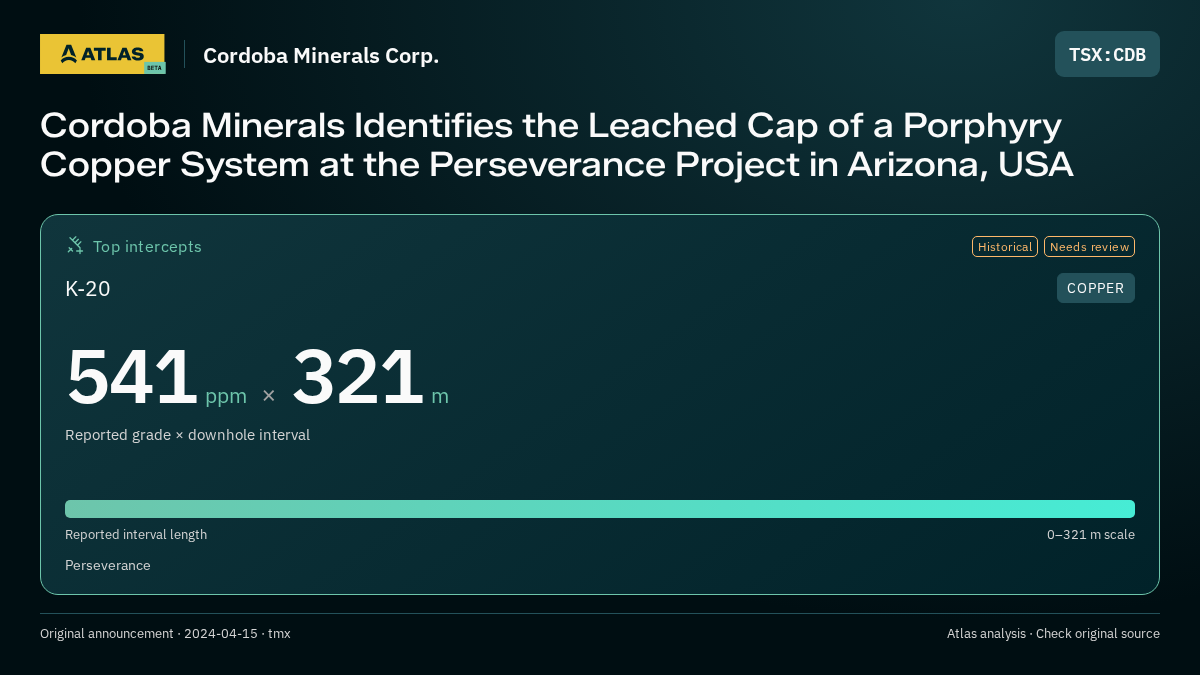
K-20Perseverance · copperGrade: 541Grade Unit: ppmIntercept: 321 mHistorical resultNeeds review: historical_restatementView all detailsHide details
Identity
- Hole ID
- K-20
- Project
- Perseverance
- Commodity
- copper
- Region
- usa_az
- Reported Region
- Arizona, USA
- Ticker
- CDB
Geometry
- Grade
- 541
- Grade Unit
- ppm
- Intercept
- 321 m
Classification
- Sample Type
- drill
Review
- Needs Review
- Yes
- Review Reason
- historical_restatement
- Interp. Status
- scored
- Historical
- Yes
- Historical Source Date
- 2021-10-19T00:00:00.000Z
Dates
- Event date
- 2024-04-15T00:00:00.000Z
Reasoning: Historical intercept of 321m at 541 ppm Cu reported as a reference to a 2021 release.
Positive factors
- Significant width of anomalous copper
Evidence · text
“Hole K-20, intersected 321 meters of anomalous copper assaying 541 ppm copper”
K-23Perseverance · copperIntercept: 74 mNeeds review: ungroundedView all detailsHide details
Identity
- Hole ID
- K-23
- Project
- Perseverance
- Commodity
- copper
- Region
- usa_az
- Reported Region
- Arizona, USA
- Ticker
- CDB
Geometry
- Intercept
- 74 m
- From
- 516 m
- To
- 590 m
Classification
- Sample Type
- drill
Review
- Needs Review
- Yes
- Review Reason
- ungrounded
- Interp. Status
- scored
- Historical
- No
Dates
- Event date
- 2024-04-15T00:00:00.000Z
Reasoning: Geological identification of a leached cap and porphyry units, but numeric grades are not yet available.
Positive factors
- Intersection of Laramide porphyry and leached cap
Negative factors
- Assays pending
Evidence · text
“Core interval between 516 meters and 590 meters in hole K-23 will be submitted for assay.”
How Atlas produces this analysis
Minestarters Atlas uses automated extraction to summarize mining announcements, identify reported measurements, and classify supporting evidence. Sentiment reflects the extracted narrative and classification rules; it is an interpretation, not a reported measurement. Evidence quotes and context are provided where available. Missing data, low-confidence results, and review flags indicate limitations. Check the original publisher announcement before relying on an interpretation.