
Cartier Cuts 7.1 g/t Au over 8.0 m at Portal (Cadillac); New Shallow High-Grade Gold Zone Discovered
Original announcement by yahoo_press on
- Company
- Cartier Resources Inc.
- Ticker
- ECR
- Exchange
- TSXV
- Region
- Quebec
- Primary commodity
- Gold
- Secondary commodities
- None reported
- Document categories
- Drill results
- Extracted
- 2026-08-24 06:25:14 UTC
Analysis by Minestarters Atlas
Minestarters Atlas analysis
Summary
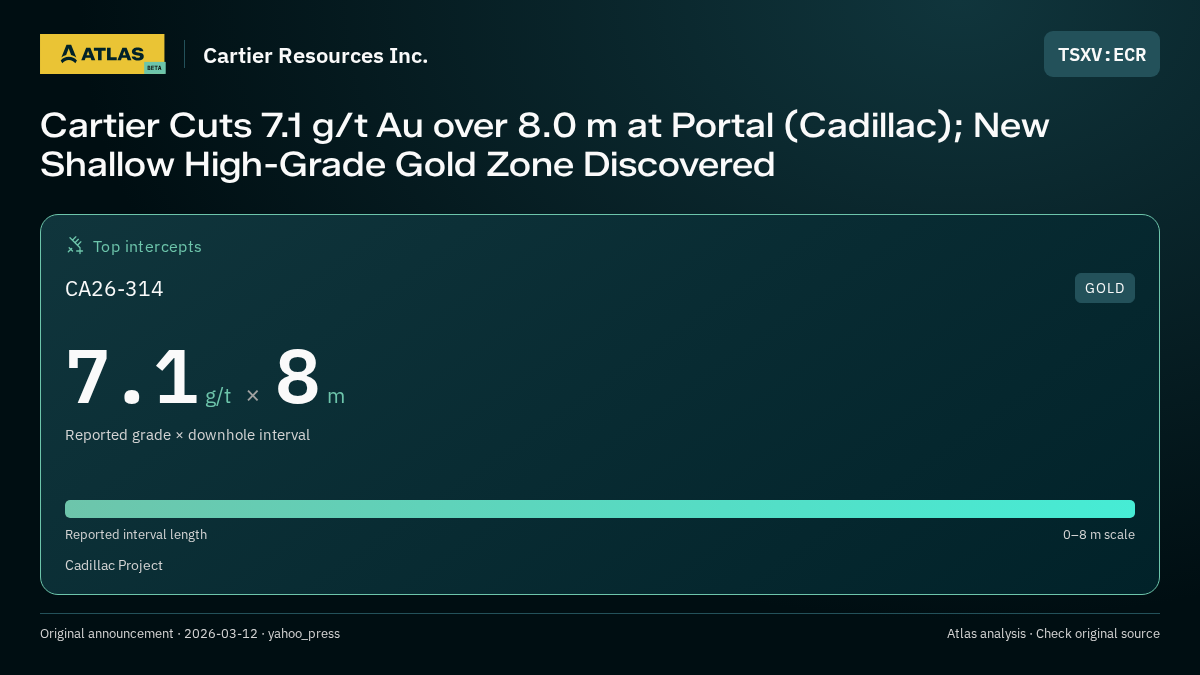
Cartier Resources announced drill results from the Portal Sector of the Cadillac Project in Quebec. Hole CA26-314 intersected 7.1 g/t gold over 8.0 metres, contributing to a new shallow high-grade gold zone discovery.
Reasoning: The intercept of 7.1 g/t Au over 8.0 m is a strong result for an exploration program and identifies a new shallow high-grade zone.
Positive factors
- high-grade intercept
- new zone discovery
Facts used in scoring: 1
Classification and evidence
Step-Out Extensionpositive
Mineralization extended beyond the previously known limit.
Why it applies: The announcement highlights the discovery of a 'New Shallow High-Grade Gold Zone'.
Evidence · text
“New Shallow High-Grade Gold Zone Discovered”
Extracted facts
Stored fact records: 1. Some facts used in scoring do not have a stored record.
Drill Results (1)
CA26-314Cadillac Project · goldGrade: 7.1Grade Unit: g/tIntercept: 8 mView all detailsHide details
Identity
- Hole ID
- CA26-314
- Project
- Cadillac Project
- Commodity
- gold
- Region
- canada_qc
- Reported Region
- Quebec
- Ticker
- ECR
Geometry
- Grade
- 7.1
- Grade Unit
- g/t
- Intercept
- 8 m
Classification
- Program
- exploration
- Sample Type
- drill
Review
- Needs Review
- No
- Interp. Status
- scored
- Historical
- No
Dates
- Event date
- 2026-03-12T00:00:00.000Z
Reasoning: 7.1 g/t over 8.0m is a solid intercept for an exploration target.
Positive factors
- strong grade-width product
Evidence · text
“CA26-314 intersected 7.1 g/t Au over 8.0 m”
How Atlas produces this analysis
Minestarters Atlas uses automated extraction to summarize mining announcements, identify reported measurements, and classify supporting evidence. Sentiment reflects the extracted narrative and classification rules; it is an interpretation, not a reported measurement. Evidence quotes and context are provided where available. Missing data, low-confidence results, and review flags indicate limitations. Check the original publisher announcement before relying on an interpretation.