
Camino Announces Filing of Pre-Feasibility Study Technical Report and Provides Update on Previously Announced Acquisition of the Puquios Copper Project
Original announcement by tmx on
- Company
- Camino Minerals Corporation
- Ticker
- COR
- Exchange
- TSX
- Region
- Coquimbo Region, Chile
- Primary commodity
- Copper
- Secondary commodities
- None reported
- Document categories
- Other, Resource update, Agreement transaction
- Extracted
- 2026-08-21 08:36:36 UTC
Analysis by Minestarters Atlas
Minestarters Atlas analysis
Summary
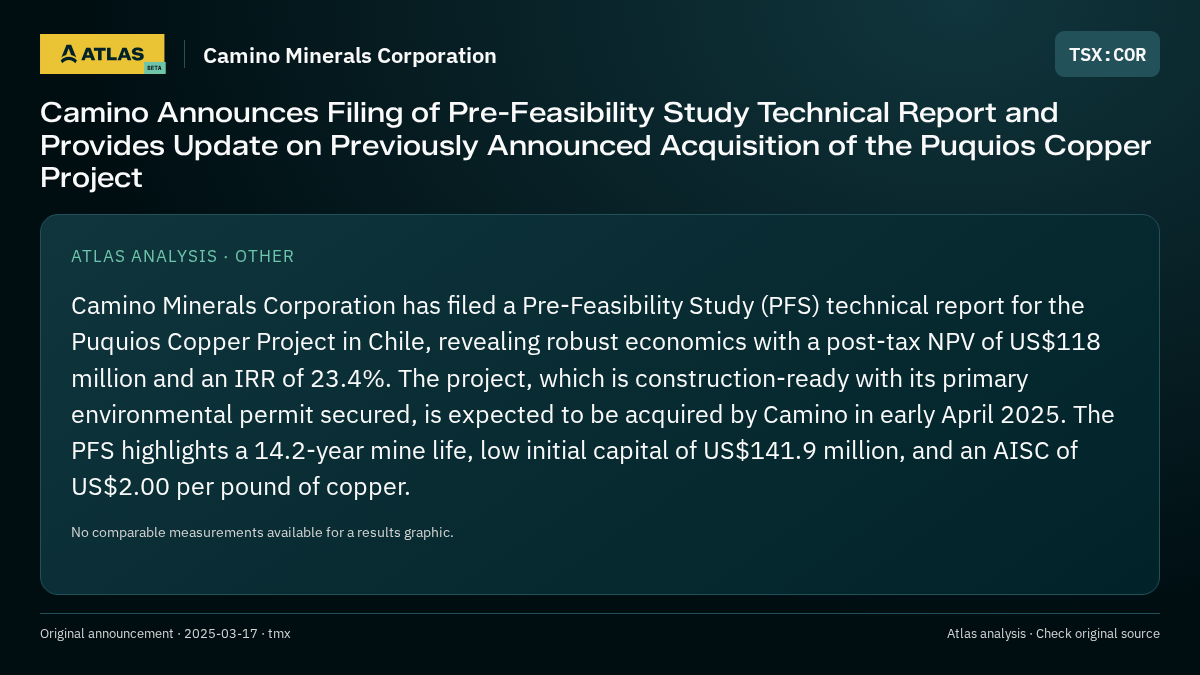
Camino Minerals Corporation has filed a Pre-Feasibility Study (PFS) technical report for the Puquios Copper Project in Chile, revealing robust economics with a post-tax NPV of US$118 million and an IRR of 23.4%. The project, which is construction-ready with its primary environmental permit secured, is expected to be acquired by Camino in early April 2025. The PFS highlights a 14.2-year mine life, low initial capital of US$141.9 million, and an AISC of US$2.00 per pound of copper.
Reasoning: Camino Minerals has filed a Pre-Feasibility Study (PFS) technical report for the Puquios Copper Project, highlighting robust economics with a post-tax NPV of US$118 million and an IRR of 23.4%. The project benefits from low initial capital and has received its primary environmental permit, positioning it as construction-ready. The acquisition of this project is a significant step towards the company becoming a copper producer, despite the resource and reserve estimates having effective dates from 2021.
Positive factors
- Robust project economics with strong post-tax NPV and IRR
- Low initial capital expenditure for a copper project
- Primary environmental permit received, advancing project towards production
- Acquisition of a construction-ready project, accelerating company's growth strategy
- Significant Measured and Indicated resource base supporting a long mine life
Negative factors
- Mineral Resource effective date is over 3 years old, potentially impacting currency
- Mineral Reserve effective date is over 3 years old, potentially impacting currency
Facts used in scoring: 37
Classification and evidence
PFS-Supportingneutral
Resource estimate prepared to support a Pre-Feasibility Study — requires adequate M&I component.
Why it applies: The document is a Pre-Feasibility Study Technical Report, providing detailed economic and technical information to support project development.
Evidence · text
“Pre-feasibilityStudy, La Higuera, Coquimbo Region, Chile”
NI 43-101 Compliantpositive
Resource estimate prepared in compliance with NI 43-101 (Canada) — high reporting standard.
Why it applies: The Puquios Project Technical Report was prepared in accordance with National Instrument 43-101.
Evidence · text
“The Puquios Project Technical Report was prepared in accordance with National Instrument 43-101 - Standards of Disclosure for Mineral Projects (" NI 43-101 ")”
QP/CP Signedpositive
Qualified Person (QP) or Competent Person (CP) named and signed off — a member of a recognized professional association (e.g., AusIMM, SME, AIG, P.Geo) with relevant experience.
Why it applies: The Mineral Resources estimate was prepared by Mr. Cristian Quiñones, RM CMC, AsGeoMin SpA, and Mineral Reserves by Jesse Aarsen, P.Eng., both identified as Qualified Persons.
Evidence · text
“The Qualified Person for the estimates is Mr. Cristian Quiñones, RM CMC, AsGeoMin SpA. ... The Mineral Reserves estimates were prepared by Jesse Aarsen, P.Eng. (who is also an Independent Qualified Person)”
Measured Resourcepositive
Highest confidence category — tonnage, grade, shape well-established from closely-spaced drilling. Basis for Proven Reserves.
Why it applies: The resource estimate includes a Measured category of 26.496 Mt at 0.475% CuT.
Evidence · text
“Measured 26,496 0.475 0.117 0.232 126”
Indicated Resourcepositive
Reasonable geological confidence based on adequate drilling; continuity can be assumed. Basis for Probable Reserves.
Why it applies: The resource estimate includes an Indicated category of 5.664 Mt at 0.399% CuT.
Evidence · text
“Indicated 5,664 0.399 0.111 0.167 23”
Inferred Resourcenegative
Speculative category — limited drilling, geological continuity assumed but not confirmed. Cannot support economic studies alone.
Why it applies: The resource estimate includes an Inferred category of 0.66 Mt at 0.295% CuT.
Evidence · text
“Inferred 660 0.295 0.133 0.059 2”
Proven Reservepositive
Measured Resource with demonstrated economic viability after applying modifying factors.
Why it applies: The reserve estimate includes a Proven category of 21.805 kT at 0.506% CuT.
Evidence · text
“Proven 21,805 0.506 24.64”
Probable Reservepositive
Indicated Resource with demonstrated economic viability after applying modifying factors.
Why it applies: The reserve estimate includes a Probable category of 4.168 kT at 0.43% CuT.
Evidence · text
“Probable 4,168 0.43 20.19”
Stale Estimatenegative
Effective date is >2 years old — data currency concern, may not reflect current geological understanding.
Why it applies: The Mineral Resources have an effective date of March 8, 2021, which is over 3 years old.
Evidence · text
“Mineral Resources have an effective date of March 8, 2021.”
Stale Estimatenegative
Effective date is >2 years old — data currency concern, may not reflect current geological understanding.
Why it applies: The Mineral Reserves estimates have an effective date of September 21, 2021, which is over 3 years old.
Evidence · text
“The Mineral Reserves estimates were prepared by Jesse Aarsen, P.Eng. (who is also an Independent Qualified Person), reported using the 2014 CIM Definition Standards, and have an effective date of September 21, 2021.”
Cut-off Disclosedpositive
Cut-off grade used for resource reporting is clearly stated, enabling like-for-like comparison.
Why it applies: The Mineral Resources are reported using a cut-off grade of 0.15% total copper (CuT).
Evidence · text
“Mineral Resources are reported using a cut-off grade of 0.15% total copper (CuT).”
Cut-off Disclosedpositive
Cut-off grade used for resource reporting is clearly stated, enabling like-for-like comparison.
Why it applies: The cut-off grade used for ore/waste determination in reserves is NSR >= US$5.59/t.
Evidence · text
“The cut-off grade used for ore/waste determination is NSR >= US$5.59/t.”
High Recoverypositive · Story-specific tag
Recovery at or above the exceptional band for the commodity and processing route.
Why it applies: The mill recovery rate of 78.80% and average metallurgical recovery of 79% are strong for a heap leach copper project.
Evidence · table
“78.80%”
Context: 25,973
Heap Leach Routeneutral · Story-specific tag
Processing via heap leach — lower CAPEX and OPEX, lower recovery expected.
Why it applies: The project utilizes heap leach copper production, which is a cost-effective method.
Evidence · text
“Heap leach copper production is one of the most cost-effective ways to build a copper mine”
Environmental Permit Receivedpositive · Story-specific tag
No canonical definition is currently available.
Why it applies: The Puquios Project has received its primary environmental permit (Resoluciones de Calificacion Ambiental - RCA).
Evidence · text
“The Puquios Project has received its primary environmental permit, Resoluciones de Calificacion Ambiental (RCA), to build and operate a mine”
Extracted facts
Stored fact records: 0. Some facts used in scoring do not have a stored record.
No stored fact records are available for this extraction.
How Atlas produces this analysis
Minestarters Atlas uses automated extraction to summarize mining announcements, identify reported measurements, and classify supporting evidence. Sentiment reflects the extracted narrative and classification rules; it is an interpretation, not a reported measurement. Evidence quotes and context are provided where available. Missing data, low-confidence results, and review flags indicate limitations. Check the original publisher announcement before relying on an interpretation.