
Black Mammoth Metals Finds Chargeability Anomalies and Stakes Claims at Cottonwood, NV
Original announcement by tmx on
- Company
- Black Mammoth Metals Corporation
- Ticker
- BMM
- Exchange
- TSX
- Region
- Nevada
- Primary commodity
- Gold
- Secondary commodities
- Arsenic, Antimony, Mercury
- Document categories
- Drill results, Other
- Extracted
- 2026-08-21 05:25:02 UTC
Analysis by Minestarters Atlas
Minestarters Atlas analysis
Summary
Black Mammoth Metals has identified significant chargeability anomalies via an IP survey at the Cottonwood target in Nevada, suggesting potential sulfide-hosted gold mineralization. The company also reported a high-grade gold sub-interval from hole CW-2B and has expanded its claim coverage.
Reasoning: The release reports new geophysical anomalies that suggest sulfide-rich gold targets and restates a high-grade sub-interval from a previous drilling campaign.
Positive factors
- high chargeability anomaly identified
- gold intercept in CW-2B
- prospective structural corridor identified
Negative factors
- deleterious elements (arsenic, antimony, mercury) noted in hydrothermal fluids
Facts used in scoring: 2
Classification and evidence
QA/QC Disclosedpositive
Release includes QA/QC disclosure — certified lab, QP sign-off, or stated methods (blanks, standards, duplicates).
Why it applies: The release mentions a Qualified Person (Mark J. Abrams, CPG #11451) has reviewed and approved the technical content.
Evidence · text
“Mark J. Abrams, CPG #11451, a Qualified Person... has reviewed and approved the technical content”
Deleterious Elements Presentnegative
Penalty elements (arsenic, antimony, etc.) or refractory concerns noted in the release.
Why it applies: Hydrothermal fluids are noted to be bearing arsenic, antimony and mercury.
Evidence · text
“strongly altered by gold, arsenic, antimony and mercury-bearing hydrothermal fluids”
Extracted facts
Stored fact records: 2. Some facts used in scoring do not have a stored record.
Drill Results (2)
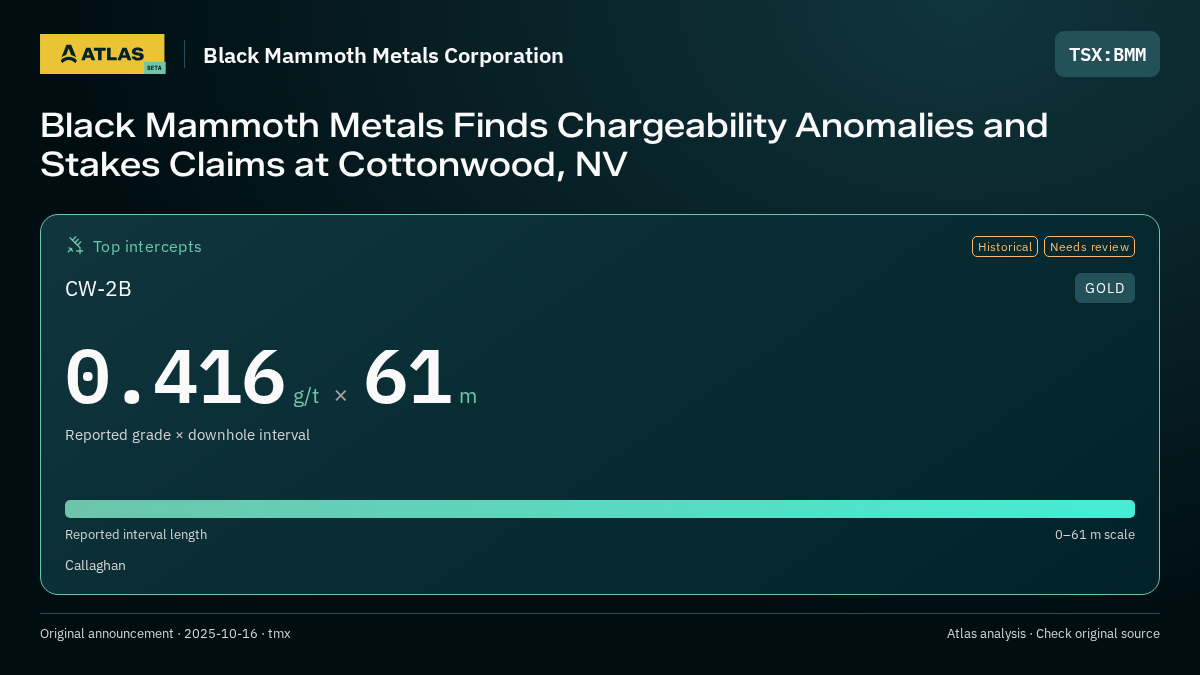
CW-2BCallaghan · goldGrade: 0.416Grade Unit: g/tIntercept: 61 mHistorical resultNeeds review: historical_restatementView all detailsHide details
Identity
- Hole ID
- CW-2B
- Project
- Callaghan
- Commodity
- gold
- Region
- usa_nv
- Reported Region
- Nevada
- Ticker
- BMM
Geometry
- Grade
- 0.416
- Grade Unit
- g/t
- Intercept
- 61 m
Classification
- Sample Type
- drill
- Group ID
- CW-2B:0-61
- Mining Method
- unknown
QA/QC
- QA/QC Disclosed
- Yes
- QP Signed
- Yes
Deleterious
- Deleterious Elements
- arsenic, antimony, mercury
Review
- Needs Review
- Yes
- Review Reason
- historical_restatement
- Interp. Status
- scored
- Historical
- Yes
- Historical Source Date
- 2025-05-14T00:00:00.000Z
Dates
- Event date
- 2025-10-16T00:00:00.000Z
Reasoning: This is a restatement of results from the 2025 spring drilling campaign.
Evidence · text
“Hole CW-2B returned the best gold intercept: 61m @ 0.416 g/t”
CW-2BCallaghan · goldGrade: 3.57Grade Unit: g/tIntercept: 3.048 mHistorical resultNeeds review: historical_restatementView all detailsHide details
Identity
- Hole ID
- CW-2B
- Project
- Callaghan
- Commodity
- gold
- Region
- usa_nv
- Reported Region
- Nevada
- Ticker
- BMM
Geometry
- Grade
- 3.57
- Grade Unit
- g/t
- Intercept
- 3.048 m
Classification
- Sample Type
- drill
- Group ID
- CW-2B:0-61
- Mining Method
- unknown
QA/QC
- QA/QC Disclosed
- Yes
- QP Signed
- Yes
Deleterious
- Deleterious Elements
- arsenic, antimony, mercury
Review
- Needs Review
- Yes
- Review Reason
- historical_restatement
- Interp. Status
- scored
- Historical
- Yes
- Historical Source Date
- 2025-05-14T00:00:00.000Z
Dates
- Event date
- 2025-10-16T00:00:00.000Z
Reasoning: High grade sub-interval restated from previous campaign.
Positive factors
- high grade sub-interval
Evidence · text
“including 3.048m @ 3.57 g/t”
How Atlas produces this analysis
Minestarters Atlas uses automated extraction to summarize mining announcements, identify reported measurements, and classify supporting evidence. Sentiment reflects the extracted narrative and classification rules; it is an interpretation, not a reported measurement. Evidence quotes and context are provided where available. Missing data, low-confidence results, and review flags indicate limitations. Check the original publisher announcement before relying on an interpretation.