
Bayhorse Silver Underground Drilling Operations Update
Original announcement by tmx on
- Company
- Bayhorse Silver Inc.
- Ticker
- BHS
- Exchange
- TSX
- Region
- Oregon, USA
- Primary commodity
- Silver
- Secondary commodities
- Copper, Zinc, Lead, Antimony
- Document categories
- Drill results, Other
- Extracted
- 2026-08-21 02:22:14 UTC
Analysis by Minestarters Atlas
Minestarters Atlas analysis
Summary
Bayhorse Silver has completed preparations for a 2,000m underground diamond drilling program at the Bayhorse Silver Mine, set to begin June 1. The program targets new IP anomalies (CR-2, CR-1, and CR-3) to extend the known silver mineralization.
Reasoning: The announcement outlines the commencement of a 2,000m underground drilling program targeting new IP anomalies, supported by high-grade historical intercepts in the area.
Positive factors
- upcoming drilling program
- high-grade historical intercepts
- IP anomaly targets identified
Negative factors
- drilling has not yet commenced
Facts used in scoring: 3
Classification and evidence
QA/QC Disclosedpositive
Release includes QA/QC disclosure — certified lab, QP sign-off, or stated methods (blanks, standards, duplicates).
Why it applies: The release mentions a Qualified Person (Mark Abrams, AIPG) has prepared and approved the technical content.
Evidence · text
“Mark Abrams, AIPG, a Qualified Person and Director of the Company has prepared, supervised the preparation of, or approved the technical content”
Infill Drillingneutral
Confirmatory drilling to raise resource confidence, not new discovery.
Why it applies: The drilling is intended to confirm presence and extend the mineralized zone near existing resources.
Evidence · text
“intended to confirm the presence of high grade silver bearing "tetrahedrite"”
Extracted facts
Stored fact records: 3. Some facts used in scoring do not have a stored record.
Drill Results (3)
DD2024-01Bayhorse Silver Mine · silverIntercept: 213 mHistorical resultNeeds review: historical_restatementView all detailsHide details
Identity
- Hole ID
- DD2024-01
- Project
- Bayhorse Silver Mine
- Commodity
- silver
- Region
- oregon, usa
- Reported Region
- Oregon, USA
- Ticker
- BHS
Geometry
- Intercept
- 213 m
Classification
- Sample Type
- drill
Review
- Needs Review
- Yes
- Review Reason
- historical_restatement
- Interp. Status
- scored
- Historical
- Yes
- Historical Source Date
- 2025-02-01T00:00:00.000Z
Dates
- Event date
- 2026-05-28T00:00:00.000Z
Reasoning: Historical intercept showing significant brecciation.
Positive factors
- strong brecciation
Evidence · text
“DD2024-01, that intersected 213 m (700 ft) of strong brecciation”
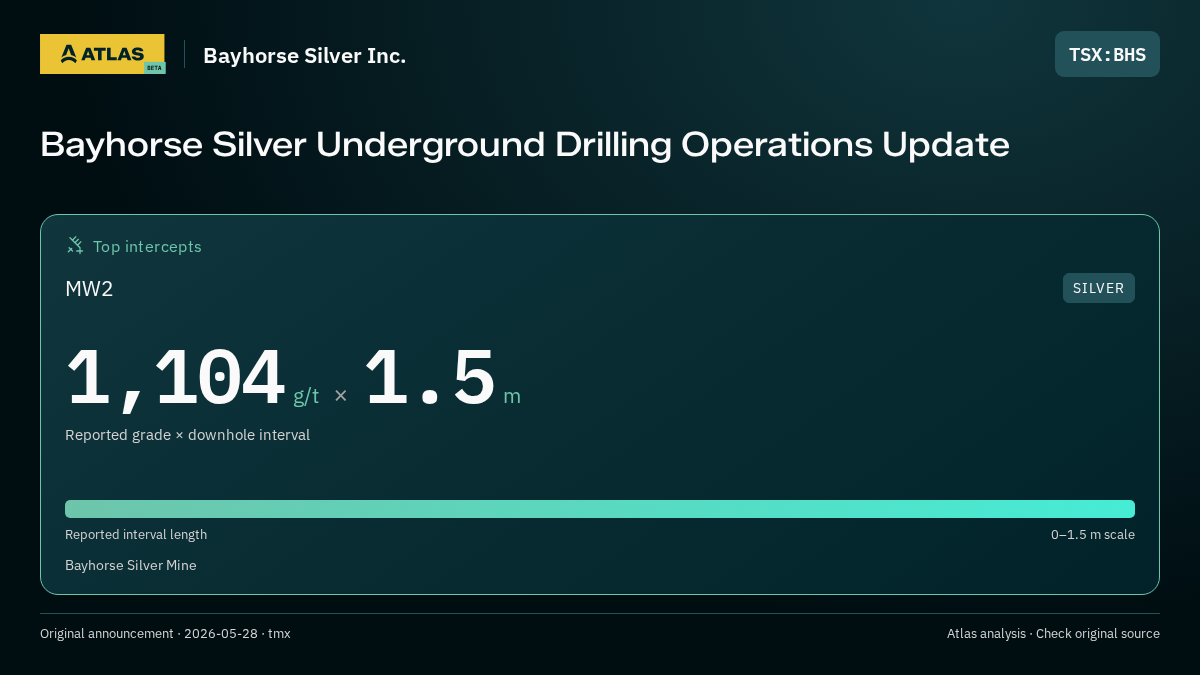
MW2Bayhorse Silver Mine · silverGrade: 1104Grade Unit: g/tIntercept: 1.5 mView all detailsHide details
Identity
- Hole ID
- MW2
- Project
- Bayhorse Silver Mine
- Commodity
- silver
- Region
- oregon, usa
- Reported Region
- Oregon, USA
- Ticker
- BHS
Geometry
- Grade
- 1104
- Grade Unit
- g/t
- Intercept
- 1.5 m
- From
- 22 m
- To
- 33.5 m
Classification
- Sample Type
- drill
Review
- Needs Review
- No
- Interp. Status
- scored
- Historical
- No
Dates
- Event date
- 2026-05-28T00:00:00.000Z
Reasoning: High-grade silver intercept from a groundwater test well.
Positive factors
- high grade
Evidence · text
“1.5 m (5 ft) grading an average of 1,104 g/t (35.46 opt) silver”
MW2Bayhorse Silver Mine · silverGrade: 770Grade Unit: g/tIntercept: 1.5 mView all detailsHide details
Identity
- Hole ID
- MW2
- Project
- Bayhorse Silver Mine
- Commodity
- silver
- Region
- oregon, usa
- Reported Region
- Oregon, USA
- Ticker
- BHS
Geometry
- Grade
- 770
- Grade Unit
- g/t
- Intercept
- 1.5 m
- From
- 22 m
- To
- 33.5 m
Classification
- Sample Type
- drill
Review
- Needs Review
- No
- Interp. Status
- scored
- Historical
- No
Dates
- Event date
- 2026-05-28T00:00:00.000Z
Reasoning: Second part of the silver intercept from MW2.
Positive factors
- strong grade
Evidence · text
“1.5 m (5 ft) averaging 770 g/t (23.12 opt) silver”
How Atlas produces this analysis
Minestarters Atlas uses automated extraction to summarize mining announcements, identify reported measurements, and classify supporting evidence. Sentiment reflects the extracted narrative and classification rules; it is an interpretation, not a reported measurement. Evidence quotes and context are provided where available. Missing data, low-confidence results, and review flags indicate limitations. Check the original publisher announcement before relying on an interpretation.