
Artemis Gold Reports Record Financial and Operating Results for Q2 2026 Artemis Gold Inc. (TSXV: ARTG) ("Artemis Gold" or the "Company") reports financial and operating results for the three- and six-month periods ended...
Original announcement by cnw on
- Company
- Artemis Gold Inc.
- Ticker
- ARTG
- Exchange
- Unavailable
- Region
- British Columbia
- Primary commodity
- Gold
- Secondary commodities
- Silver
- Document categories
- Production, Metallurgy
- Extracted
- 2026-08-24 03:55:56 UTC
Analysis by Minestarters Atlas
Minestarters Atlas analysis
Summary
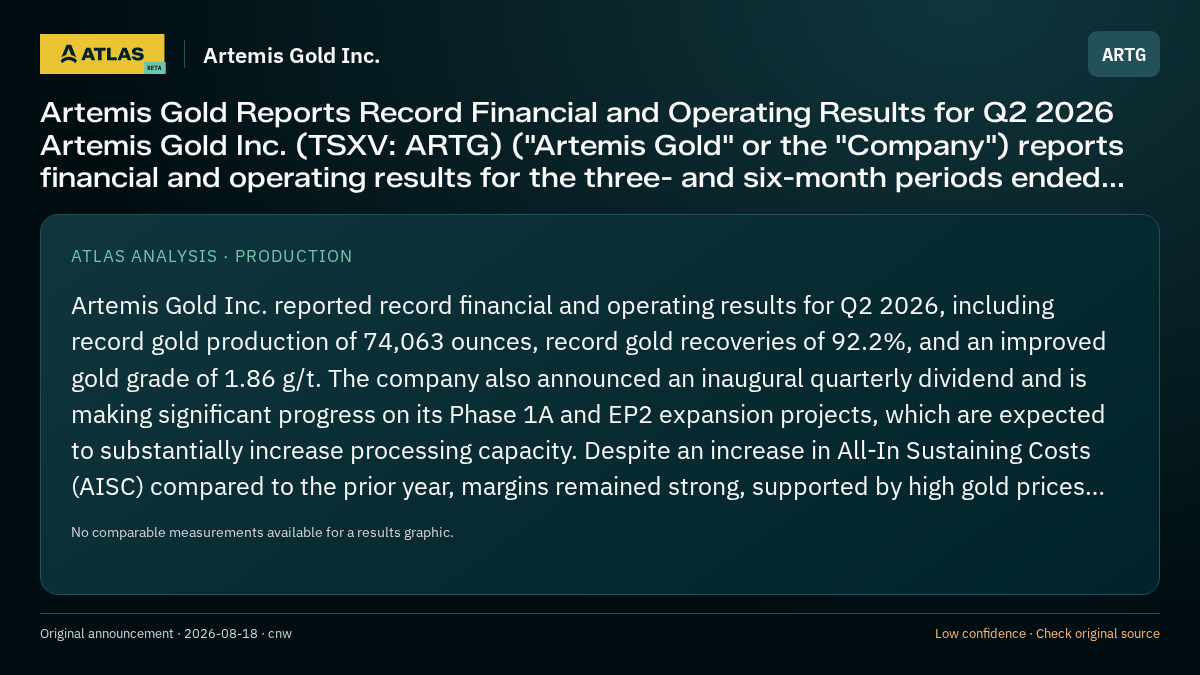
Artemis Gold Inc. reported record financial and operating results for Q2 2026, including record gold production of 74,063 ounces, record gold recoveries of 92.2%, and an improved gold grade of 1.86 g/t. The company also announced an inaugural quarterly dividend and is making significant progress on its Phase 1A and EP2 expansion projects, which are expected to substantially increase processing capacity. Despite an increase in All-In Sustaining Costs (AISC) compared to the prior year, margins remained strong, supported by high gold prices and low operating costs.
Reasoning: The company achieved record gold production, recoveries, and financial metrics, while advancing significant expansion projects and initiating a dividend, though AISC increased and there's a note on lower-grade ore reconciliation.
Positive factors
- Record quarterly production of 74,063 ounces of gold.
- Record gold recoveries of 92.2% in Q2 2026, up from 84.0% in Q2 2025.
- Plant feed grades averaged 1.86 g/t gold, up from 1.34 g/t in Q2 2025.
- Record adjusted EBITDA of $285.2 million and net cash from operating activities of $207.5 million.
- Phase 1A expansion is 57% complete and on schedule for commissioning in Q4 2026, increasing capacity by 33%.
- EP2 project has commenced major works construction ahead of schedule and is on budget, expanding throughput capacity to 21 Mtpa by Q4 2028.
- Inaugural quarterly dividend of $0.05 per share declared.
Negative factors
- All-in sustaining costs (AISC) increased to US$955 per ounce in Q2 2026 from US$805 per ounce in Q2 2025.
- AISC margin decreased to 71% from 80% in Q2 2025.
- Grade control drilling reconciliation shows more low and medium grade ore tonnes than predicted in the Mineral Resource, requiring expanded stockpile capacity.
Low confidence — this extraction should be reviewed alongside the original source.
Facts used in scoring: 22
Classification and evidence
High Recoverypositive
Recovery at or above the exceptional band for the commodity and processing route.
Why it applies: Gold recoveries in the mill improved to a record 92.2% in Q2 2026, which is above the exceptional band for milling circuits.
Evidence · text
“Gold recoveries in the mill improved to a record 92.2% in the quarter”
Recovery Improvingpositive
Recovery improved versus a like-for-like prior test program on the same domain and route.
Why it applies: Gold recoveries improved from 84.0% in Q2 2025 to a record 92.2% in Q2 2026, representing a significant increase.
Evidence · text
“Gold recoveries in the mill improved to a record 92.2% in the quarter, up from 84.0% in Q2 2025”
Production Increasepositive · Story-specific tag
No canonical definition is currently available.
Why it applies: The Blackwater Mine produced a record 74,063 ounces of gold in Q2 2026, indicating increased output.
Evidence · text
“The Blackwater Mine produced a record 74,063 ounces of gold in Q2 2026.”
Grade Improvementpositive · Story-specific tag
Average resource grade improved vs prior estimate — better deposit economics.
Why it applies: Plant feed grades averaged 1.86 g/t gold during Q2 2026, which is an increase from 1.34 g/t gold in Q2 2025.
Evidence · text
“Plant feed grades averaged 1.86 grams per tonne (g/t) gold during the quarter, up from 1.34 g/t gold in Q2 2025.”
AISC Increasenegative · Story-specific tag
No canonical definition is currently available.
Why it applies: All-in sustaining costs (AISC) increased to US$955 per ounce in Q2 2026 from US$805 per ounce in Q2 2025.
Evidence · text
“The Company reported AISC of US$955 and US$1,013 per ounce of gold sold in Q2 2026 and YTD 2026, respectively, versus US$805 per ounce of gold sold in May and June 2025.”
Resource Dilution Risknegative · Story-specific tag
No canonical definition is currently available.
Why it applies: Grade control drilling reconciliation continues to show more low and medium grade ore tonnes than predicted in the Mineral Resource, suggesting potential for resource dilution.
Evidence · text
“The grade control drilling reconciliation continues to show more low and medium grade ore tonnes than predicted in the Mineral Resource and the stockpile capacity is being expanded to accommodate it.”
Dividend Declaredpositive · Story-specific tag
No canonical definition is currently available.
Why it applies: The Board of Directors declared an inaugural quarterly dividend of $0.05 per share.
Evidence · text
“As announced on August 5, 2026, the Board of Directors declared an inaugural quarterly dividend of $0.05 per share”
Expansion Projectpositive · Story-specific tag
No canonical definition is currently available.
Why it applies: The company is progressing well on its Phase 1A and EP2 growth projects, which will significantly expand throughput capacity.
Evidence · text
“We are progressing very well on our Phase 1A and EP2 growth projects”
Extracted facts
Stored fact records: 0. Some facts used in scoring do not have a stored record.
No stored fact records are available for this extraction.
How Atlas produces this analysis
Minestarters Atlas uses automated extraction to summarize mining announcements, identify reported measurements, and classify supporting evidence. Sentiment reflects the extracted narrative and classification rules; it is an interpretation, not a reported measurement. Evidence quotes and context are provided where available. Missing data, low-confidence results, and review flags indicate limitations. Check the original publisher announcement before relying on an interpretation.