
Arizona Metals Files Technical Report for the Kay Mine Project
Original announcement by tmx on
- Company
- Arizona Metals Corp.
- Ticker
- AMC
- Exchange
- TSX
- Region
- Arizona
- Primary commodity
- Copper
- Secondary commodities
- Gold, Zinc, Lead, Silver
- Document categories
- Resource update, Other
- Extracted
- 2026-08-21 07:33:45 UTC
Analysis by Minestarters Atlas
Minestarters Atlas analysis
Summary
Arizona Metals Corp. has filed an independent NI 43-101 technical report supporting the first mineral resource estimate for its Kay Mine Project in Arizona. The report covers a Cu-Au-Zn-Pb-Ag VMS deposit and was authored by independent Qualified Persons from SGS.
Reasoning: The company has filed its first-ever NI 43-101 technical report supporting a maiden mineral resource estimate for the Kay Mine Project, a significant milestone for the project's development.
Positive factors
- Maiden resource estimate filed
- NI 43-101 compliant technical report
- Qualified Persons named
- VMS deposit type with expansion potential
Negative factors
- Historic estimate at Sugarloaf Peak remains unverified
Facts used in scoring: 1
Classification and evidence
Maiden Resourceneutral
First formal MRE for the project — establishes baseline but typically exploration-stage with high Inferred component.
Why it applies: The company announced the filing of the technical report supporting the 'first ever mineral resource estimate' for the Kay Mine Project.
Evidence · text
“supporting the first ever mineral resource estimate in respect of the Company's Kay Mine Project”
NI 43-101 Compliantpositive
Resource estimate prepared in compliance with NI 43-101 (Canada) — high reporting standard.
Why it applies: The technical report was filed in accordance with NI 43-101 standards.
Evidence · text
“filed on SEDAR+ in accordance with National 43-101 – Standards of Disclosure for Mineral Projects (" NI 43-101 ")”
QP/CP Signedpositive
Qualified Person (QP) or Competent Person (CP) named and signed off — a member of a recognized professional association (e.g., AusIMM, SME, AIG, P.Geo) with relevant experience.
Why it applies: Independent Qualified Persons from SGS Geological Services authored the report.
Evidence · text
“authored by Allan Armitage, PhD, P. Geo., and Ben Eggers, MAIF, P. Geo., of SGS Geological Services (" SGS ")”
Historical Estimate Onlynegative
Estimate pre-dates or does not comply with current JORC/NI 43-101 standards — requires verification drilling.
Why it applies: The Sugarloaf Peak estimate is a 1983 report that has not been verified as a current resource.
Evidence · text
“The historic estimate at the Sugarloaf Peak Project was reported by Westworld Resources in 1983. The historic estimate has not been verified as a current mineral resource.”
Extracted facts
Stored fact records: 1. Some facts used in scoring do not have a stored record.
Resource Estimates (1)
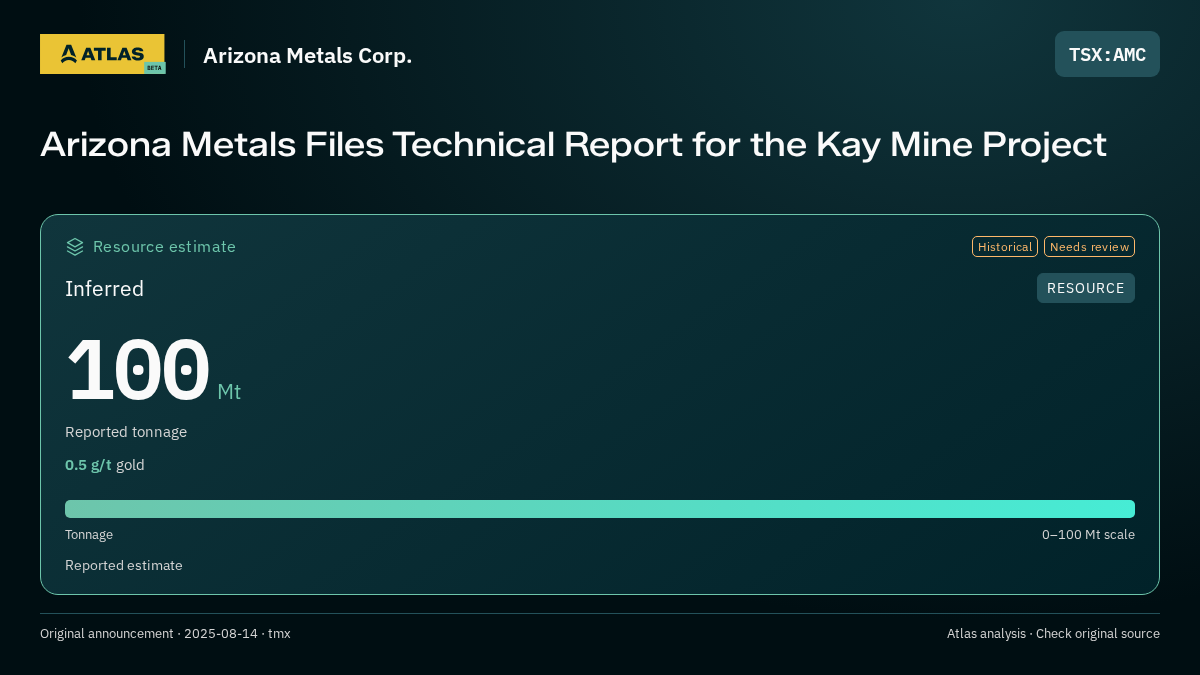
inferredgoldTonnes: 100000000Grade: 0.5Grade Unit: g/tHistorical resultNeeds review: historical_restatementView all detailsHide details
Identity
- Commodity
- gold
- Ticker
- AMC
Resource Data
- Category
- inferred
- Tonnes
- 100000000
- Grade
- 0.5
- Grade Unit
- g/t
Review
- Needs Review
- Yes
- Review Reason
- historical_restatement
- Historical
- Yes
- Historical Source Date
- 1983-01-01T00:00:00.000Z
Dates
- Event date
- 2025-08-14T00:00:00.000Z
Reasoning: This is a restatement of a 1983 historic estimate that the company explicitly states has not been verified as a current mineral resource.
Negative factors
- Unverified historic estimate
- No resource categories used in original report
- Assumptions and methods not reported
Evidence · text
“historic estimate of "100 million tons containing 1.5 million ounces gold" at a grade of 0.5 g/t”
How Atlas produces this analysis
Minestarters Atlas uses automated extraction to summarize mining announcements, identify reported measurements, and classify supporting evidence. Sentiment reflects the extracted narrative and classification rules; it is an interpretation, not a reported measurement. Evidence quotes and context are provided where available. Missing data, low-confidence results, and review flags indicate limitations. Check the original publisher announcement before relying on an interpretation.