
American Creek's JV Partner Tudor Gold Announces Positive Results from Initial Metallurgical Testing for the High-Grade Gold Supercell-One Complex Within the Goldstorm Deposit, at Treaty Creek, Located in the Heart of the Golden Triangle, British Columbia
Original announcement by tmx on
- Company
- American Creek Resources Ltd.
- Ticker
- AMK
- Exchange
- TSX
- Region
- British Columbia
- Primary commodity
- Gold
- Secondary commodities
- Copper, Silver
- Document categories
- Metallurgy
- Extracted
- 2026-08-22 22:51:17 UTC
Analysis by Minestarters Atlas
Minestarters Atlas analysis
Summary
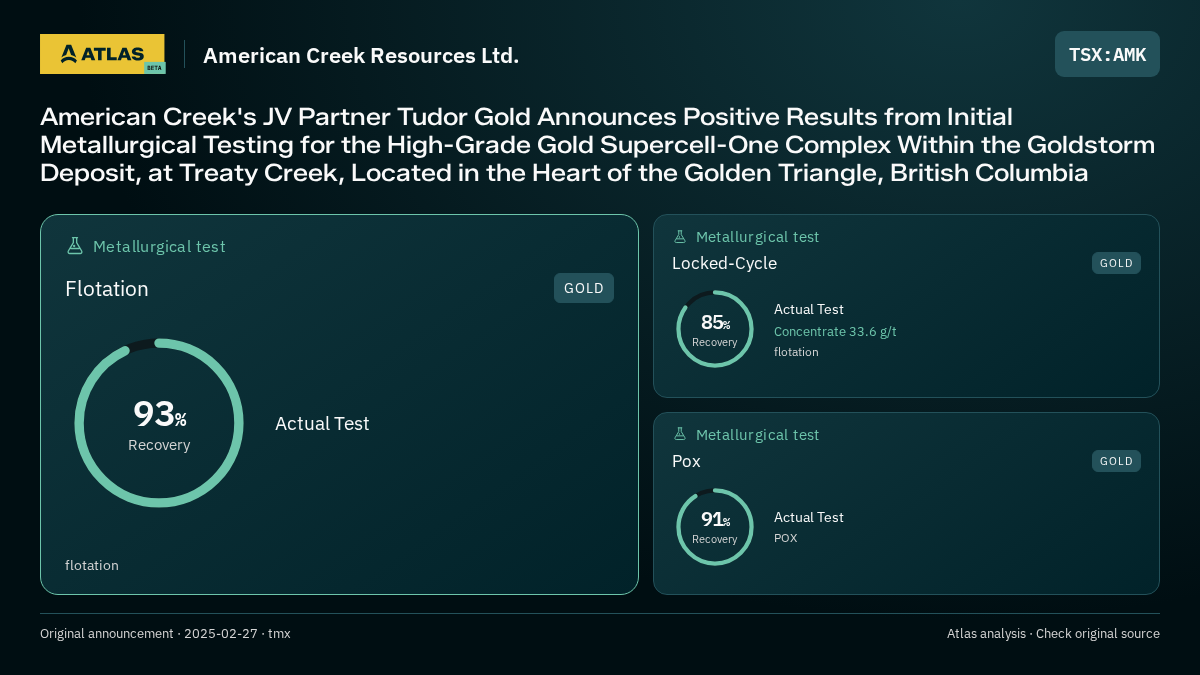
Tudor Gold has announced positive initial metallurgical results for the high-grade gold Supercell-One (SC-1) complex at the Treaty Creek Project. Flotation testing achieved up to 93% gold recovery and produced a 33.6 g/t gold concentrate, although deleterious elements like arsenic and antimony were detected.
Reasoning: Initial metallurgical testing on the new SC-1 complex shows strong flotation and POX recoveries, though concentrate quality is impacted by penalty elements.
Positive factors
- High flotation recoveries achieved (up to 93%)
- Saleable concentrate grade of 33.6 g/t gold
- Successful POX testing (>91% recovery)
- Discovery of new high-grade complex (SC-1)
Negative factors
- Presence of deleterious elements (arsenic, antimony, bismuth, mercury) in concentrate
- Significant gold locked in sulphides (42%)
Facts used in scoring: 4
Classification and evidence
High Recoverypositive
Recovery at or above the exceptional band for the commodity and processing route.
Why it applies: Flotation recoveries reached up to 93% for gold.
Evidence · text
“achieving impressive recovery rates of 91-93% at the rougher stage”
Deleterious Elements Presentnegative · Story-specific tag
Penalty elements (arsenic, antimony, etc.) or refractory concerns noted in the release.
Why it applies: Concentrate contains arsenic, antimony, bismuth, and mercury.
Evidence · text
“the cleaner concentrate contains some deleterious elements such as 0.8% arsenic, 0.3% antimony, 0.005% bismuth, and 0.04% mercury.”
Refractory Orenegative
Ore requires oxidation/pressure treatment before recovery — a processing and recovery risk.
Why it applies: 42% of gold is locked in sulphides, requiring POX or flotation.
Evidence · text
“A significant portion of gold (42%) was found to be locked in sulphides.”
Extracted facts
Stored fact records: 4. Some facts used in scoring do not have a stored record.
Metallurgical Results (4)
flotationgoldRecovery: 93 %View all detailsHide details
Identity
- Commodity
- gold
- Ticker
- AMK
Test Work
- Program Status
- preliminary
- Test Type
- flotation
- Processing Route
- flotation
- Sample
- SC1-C and SC-1D composites (fresh, non-oxidized material)
- Grind P80
- 75 µm
Recovery
- Recovery
- 93 %
- Recovery Basis
- actual_test
Lab
- Laboratory
- SGS
Review
- Needs Review
- No
- Historical
- No
Dates
- Event date
- 2025-02-27T00:00:00.000Z
Reasoning: High recovery rate at 75 micron grind.
Positive factors
- Impressive rougher stage recovery
Evidence · text
“achieving impressive recovery rates of 91-93% at the rougher stage with a primary grind of 75 microns”
locked-cyclegoldRecovery: 85 %View all detailsHide details
Identity
- Commodity
- gold
- Ticker
- AMK
Test Work
- Program Status
- preliminary
- Test Type
- locked-cycle
- Processing Route
- flotation
- Sample
- SC1-C and SC-1D composites (fresh, non-oxidized material)
- Grind P80
- 75 µm
Recovery
- Recovery
- 85 %
- Recovery Basis
- actual_test
- Conc. Grade
- 33.6
- Conc. Grade Unit
- g/t
- Mass Pull
- 17 %
Lab
- Laboratory
- SGS
Review
- Needs Review
- No
- Historical
- No
Dates
- Event date
- 2025-02-27T00:00:00.000Z
Reasoning: Locked cycle testing produced a high-grade concentrate but with penalty elements.
Positive factors
- Saleable concentrate grade
Negative factors
- Deleterious elements present
Evidence · text
“Locked cycle testing yielded 85% overall recovery, producing a saleable concentrate with gold content of 33.6 g/t.”
poxgoldRecovery: 91 %View all detailsHide details
Identity
- Commodity
- gold
- Ticker
- AMK
Test Work
- Program Status
- preliminary
- Test Type
- pox
- Processing Route
- POX
- Sample
- SC1-C and SC-1D composites (fresh, non-oxidized material)
Recovery
- Recovery
- 91 %
- Recovery Basis
- actual_test
Review
- Needs Review
- No
- Historical
- No
Dates
- Event date
- 2025-02-27T00:00:00.000Z
Reasoning: Whole ore POX performed well.
Positive factors
- High extraction rate
Evidence · text
“Whole ore POX performed well, yielding over 91% gold extraction after 24 hours.”
cyanide leachgoldRecovery: 46.8 %View all detailsHide details
Identity
- Commodity
- gold
- Ticker
- AMK
Test Work
- Program Status
- preliminary
- Test Type
- cyanide leach
- Processing Route
- cyanide leach
- Sample
- SC1-C and SC-1D composites (fresh, non-oxidized material)
- Grind P80
- 75 µm
Recovery
- Recovery
- 46.8 %
- Recovery Basis
- actual_test
Review
- Needs Review
- No
- Historical
- No
Dates
- Event date
- 2025-02-27T00:00:00.000Z
Reasoning: Cyanide leach recovery was relatively low, suggesting gold is locked in sulphides.
Negative factors
- Low recovery compared to flotation/POX
Evidence · text
“The cyanide leach at a primary grind of 75 microns recovered 46.8% gold.”
How Atlas produces this analysis
Minestarters Atlas uses automated extraction to summarize mining announcements, identify reported measurements, and classify supporting evidence. Sentiment reflects the extracted narrative and classification rules; it is an interpretation, not a reported measurement. Evidence quotes and context are provided where available. Missing data, low-confidence results, and review flags indicate limitations. Check the original publisher announcement before relying on an interpretation.