
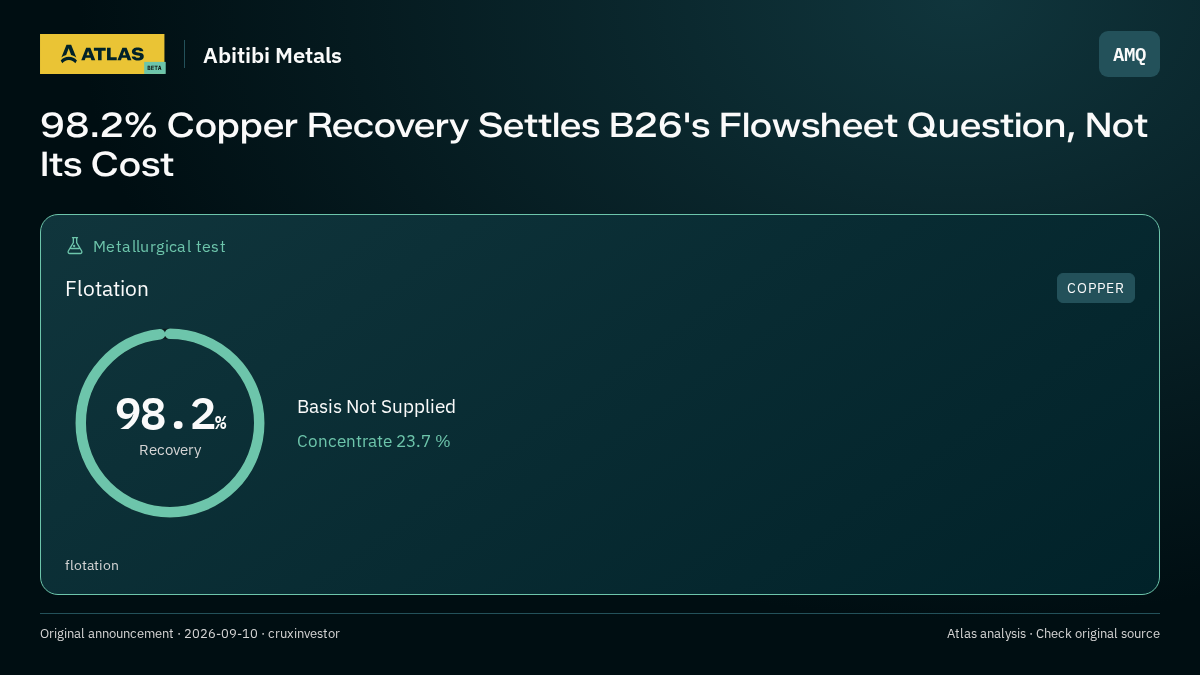
98.2% Copper Recovery Settles B26's Flowsheet Question, Not Its Cost
Original announcement by cruxinvestor on
- Company
- Abitibi Metals
- Ticker
- AMQ
- Exchange
- Unavailable
- Region
- Quebec
- Primary commodity
- Copper
- Secondary commodities
- Gold, Silver, Zinc
- Document categories
- Metallurgy, Resource update
- Extracted
- 2026-09-10 15:03:52 UTC
Analysis by Minestarters Atlas
Minestarters Atlas analysis
Summary
Abitibi Metals reported 98.2% copper recovery from flotation testwork on a representative composite from the B26 deposit in Quebec. While the results suggest a simple flotation circuit due to rapid kinetics and a coarse grind, the company cautions that final recoveries and capital costs are not yet determined.
Reasoning: Strong initial copper flotation results from a more representative composite, though full flowsheet de-risking (zinc and cleaning stages) is incomplete.
Positive factors
- High copper recovery (98.2%)
- Rapid flotation kinetics suggesting simple circuit design
- Coarse primary grind requirement
- Larger/more representative composite than previous studies
Negative factors
- Laboratory-scale results may not replicate at commercial scale
- Rougher stage results may not represent final recoveries
- Zinc, cleaner, and locked-cycle testing still outstanding
- Cost/CapEx implications remain unquantified
Facts used in scoring: 5
Classification and evidence
High Recoverypositive
Recovery at or above the exceptional band for the commodity and processing route.
Why it applies: 98.2% copper recovery is exceptional for flotation
Evidence · text
“98.2% copper recovery”
Bench Scale Onlynegative
Only preliminary bench tests completed — no locked-cycle or pilot work.
Why it applies: Results obtained using laboratory-scale equipment
Evidence · text
“Both came off laboratory-scale equipment rather than a plant.”
Mill Routeneutral
Processing via mill or concentrator (CIL, CIP, tank leach, flotation).
Why it applies: the document describes a mill_cil route ("CIL")
Single Domain Onlynegative
Testing limited to one composite or domain — representativeness not established.
Why it applies: only one composite was tested
Extracted facts
Stored fact records: 5. Some facts used in scoring do not have a stored record.
Metallurgical Results (5)
flotationB26 · copperRecovery: 98.2 %View all detailsHide details
Identity
- Project
- B26
- Commodity
- copper
- Region
- canada_qc
- Reported Region
- Quebec
- Ticker
- AMQ
Test Work
- Program Status
- preliminary
- Test Type
- flotation
- Processing Route
- flotation
- Sample
- composite from B26's copper zone
Recovery
- Recovery
- 98.2 %
- Conc. Grade
- 23.7
- Conc. Grade Unit
- %
Lab
- Laboratory
- SLR Consulting
Review
- Needs Review
- No
- Historical
- No
Dates
- Event date
- 2026-09-10T00:00:00.000Z
Reasoning: High recovery and favorable kinetics on a representative composite.
Positive factors
- 98.2% recovery is exceptional
- Rapid kinetics suggest low residence time
Negative factors
- Laboratory scale
- Rougher stage only
Evidence · text
“Flotation on a composite from B26's copper zone recovered 98.2% of the copper into a first-stage concentrate grading 23.7% copper”
Tags used in scoring
Mill Routeneutral
Processing via mill or concentrator (CIL, CIP, tank leach, flotation).
Why it applies: processing_route matches the flotation signal
High Recoverypositive
Recovery at or above the exceptional band for the commodity and processing route.
Why it applies: 98.2% is at or above the exceptional band (92%)
Byproduct Commodityneutral
The tested commodity is a byproduct rather than the primary economic driver.
Why it applies: the release describes a byproduct credit
Fact 2B26 · copperView all detailsHide details
Identity
- Project
- B26
- Commodity
- copper
- Region
- canada_qc
- Reported Region
- Quebec
- Ticker
- AMQ
Review
- Needs Review
- No
- Historical
- No
Dates
- Event date
- 2026-09-10T00:00:00.000Z
Reasoning: Standard indicated resource component of the copper zone.
Evidence · text
“the copper zone accounts for 9.29 million metric tons of indicated resource at 1.60% copper”
Tags used in scoring
Byproduct Commodityneutral
The tested commodity is a byproduct rather than the primary economic driver.
Why it applies: the release describes a byproduct credit
Fact 3B26 · copperView all detailsHide details
Identity
- Project
- B26
- Commodity
- copper
- Region
- canada_qc
- Reported Region
- Quebec
- Ticker
- AMQ
Review
- Needs Review
- No
- Historical
- No
Dates
- Event date
- 2026-09-10T00:00:00.000Z
Reasoning: Standard inferred resource component of the copper zone.
Evidence · text
“11.82 million metric tons of inferred resource at 1.67% copper”
Tags used in scoring
Byproduct Commodityneutral
The tested commodity is a byproduct rather than the primary economic driver.
Why it applies: the release describes a byproduct credit
Fact 4B26 · zincView all detailsHide details
Identity
- Project
- B26
- Commodity
- zinc
- Region
- canada_qc
- Reported Region
- Quebec
- Ticker
- AMQ
Review
- Needs Review
- No
- Historical
- No
Dates
- Event date
- 2026-09-10T00:00:00.000Z
Reasoning: Indicated zinc resource in the secondary zone.
Evidence · text
“the zinc horizon holds 3.27 million metric tons of indicated resource at 4.02% zinc”
Tags used in scoring
Byproduct Commodityneutral
The tested commodity is a byproduct rather than the primary economic driver.
Why it applies: the release describes a byproduct credit
Fact 5B26 · zincView all detailsHide details
Identity
- Project
- B26
- Commodity
- zinc
- Region
- canada_qc
- Reported Region
- Quebec
- Ticker
- AMQ
Review
- Needs Review
- No
- Historical
- No
Dates
- Event date
- 2026-09-10T00:00:00.000Z
Reasoning: Inferred zinc resource in the remobilized zone.
Evidence · text
“a remobilized silver-zinc zone adds 0.40 million metric tons at 2.55% zinc”
Tags used in scoring
Byproduct Commodityneutral
The tested commodity is a byproduct rather than the primary economic driver.
Why it applies: the release describes a byproduct credit
How Atlas produces this analysis
Minestarters Atlas uses automated extraction to summarize mining announcements, identify reported measurements, and classify supporting evidence. Sentiment reflects the extracted narrative and classification rules; it is an interpretation, not a reported measurement. Evidence quotes and context are provided where available. Missing data, low-confidence results, and review flags indicate limitations. Check the original publisher announcement before relying on an interpretation.